a look at the first season’s haunting blend of memory, loss, and survival.
Stranger Things was never about the ’80s for me. Well, that’s not entirely true. A small part of it was because of the music and culture it represented. Being an extremely nostalgic person myself, I already was attached to eras I wasn’t born into, hence why I can’t ignore the fact that I enjoyed it happening in the ’80s. The show’s playlist is enough for me to make this claim. Now that we’ve cleared that up, let’s proceed.
When people talk about the series, they often describe it as a love letter to Spielberg or Carpenter, a nostalgic blend of synths and bike rides through fog, or simply a show about children. But I’ve never seen it that way. From the very beginning, Stranger Things felt less like an homage to the past and more like a confrontation with it — a story about what happens when innocence collides with inherited trauma, and when childhood becomes the last refuge against a world that’s already broken.
In my previous piece on Stranger Things: The First Shadow, I wrote about where that darkness began — how Hawkins was never just a town, but a wound disguised as a community. That play peeled back the origins of the supernatural forces and the emotional fractures that would echo decades later. Season 1 picks up those echoes, not as a direct continuation, but as an inheritance. The monsters are different, the faces new, but the unease remains the same.
What’s always struck me about Season 1 is how ordinary it begins. A basement, a board game, a missing boy. Even when rewatching the first season, there’s comfort in that stillness, in the hum of fluorescent lights and the soft glow of Christmas bulbs — until those same lights start to speak.
In the grand scheme of things, Season 1 doesn’t ask us to remember the past — it asks us to understand how the past never really ended.
The Ordinary and the Otherworldly
Hawkins, Indiana, was never extraordinary. That’s what makes it terrifying. The horror of Stranger Things doesn’t begin in the Upside Down — it begins in basements, living rooms, and school hallways, in the places that should feel safe. The first season builds its tension not from monsters hiding in the dark, but from the unsettling idea that the familiar world can suddenly stop behaving the way it should.
From the moment Will Byers disappears, ordinary spaces begin to warp. Joyce’s home — once cramped but warm — becomes a haunted communication channel. The school, with its buzzing fluorescents and tile corridors, turns into a site of quiet dread. Even the woods, where kids ride their bikes in freedom, shift into a place of whispers and absence. Stranger Things roots its supernatural in the domestic, making horror feel like it’s next door, and as close as the next flicker of a light bulb.
Visually, the show mirrors this collapse of normalcy. Soft amber glows — the color of suburban comfort — are swallowed by a cold, sterile blue, the palette of laboratories and nightmares, the one we’ve come to associate with the Upside Down. It’s as if the world of childhood, bathed in warmth, is constantly being invaded by an adult world that’s already gone gray, even though the adults in the show have nothing to do with it. The lighting, the sound design, even the silence all contribute to that eerie sense of intrusion: safety dissolving into uncertainty, wonder turning into fear.
This tension between the ordinary and the otherworldly isn’t just visual — it’s emotional. The children see the world as a series of rules that can be learned, quests that can be won (we see this in their obsession and dedication to the game Dungeons & Dragons). The adults, on the other hand, move through it like survivors of something they can’t name. Season 1 captures that precise moment when those two realities collide — when childhood’s sense of structure meets the chaos of adulthood’s disillusionment, and in a way, the scariest revelation isn’t the monster—it’s that adults have no answers.
In The First Shadow, that same fragility hovered beneath the surface of 1959 Hawkins — a world already cracking under the pressure of hidden experiments and quiet grief. By Season 1, those cracks have completely widened into portals. The ordinary has never been stable here; it’s just been pretending.
The Fellowship of the Lost
When Stranger Things premiered, it was easy to mistake the kids for a tribute to the decade. But from the first episode, it’s clear that these children aren’t there to remind us of the past or make us take a look at life in the 1980s. They’re there to rebuild what the adults have already lost, they just don’t know it yet.
Mike, Lucas, Dustin, and Will begin as archetypes — the leader, the skeptic, the heart, the missing piece — but the show quickly complicates them, and incredibly so. Their world isn’t protected by innocence; it’s defined by how fast they have to outgrow it. In a town where adults are paralyzed by grief, bureaucracy, or disbelief, the children become the only functioning system of trust. Their friendship is infrastructure — a moral and emotional network that replaces every failed institution around them – and represents a big part of the core of the show.
Dungeons & Dragons, the controversial fantasy tabletop role-playing game where a group of players create characters to go on adventures, the story’s most recognizable prop, becomes their way of understanding chaos. What starts as a game becomes language: the Demogorgon isn’t just a monster, it’s a metaphor for everything nameless and dangerous that’s entered their lives. When adults dismiss their fears as imagination, the kids use imagination instead. Their playfulness is what keeps them alive. What further grounds this is the fact that throughout the whole show, the children are the ones giving names to these monsters that start appearing, and the adults barely question it, immediately adopting the names in their own conversations.
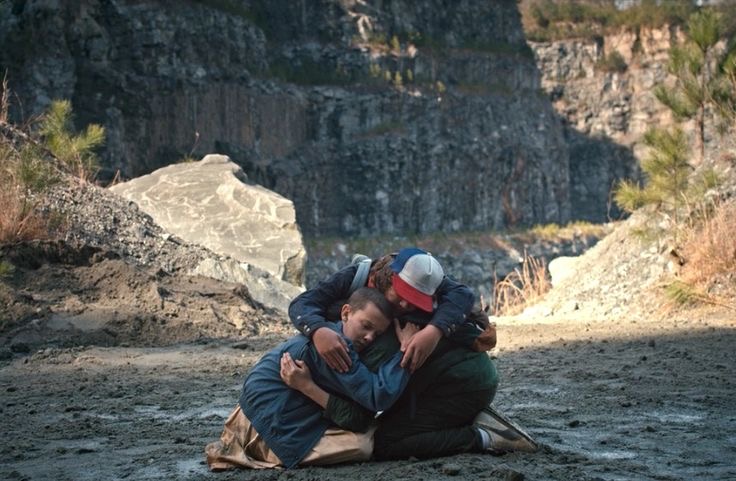
Each child carries a shard of that shared burden. Mike leads because he must — his loyalty to Will turns leadership into devotion. Lucas doubts because he’s afraid of losing another friend, his skepticism rooted in love. Dustin holds the group together, his humor a shield against panic. And Eleven — the ghost of someone else’s experiment — embodies what happens when childhood itself becomes a weaponized commodity. Together, they form a kind of emotional resistance, a found family built not through nostalgia but necessity. Alongside the younger group, the teenagers—Nancy Wheeler, Jonathan Byers, and Steve Harrington—reflect another stage of that same struggle between innocence and adulthood. Nancy’s determination to uncover the truth mirrors the younger kids’ curiosity but is tinged with guilt and fear; she wants to act like an adult but keeps finding that adults don’t have the answers. Jonathan’s quiet resilience and empathy ground the story in emotional realism, while Steve’s initial arrogance slowly gives way to responsibility. Together, they form a secondary arc of transformation—one that complements the children’s imaginative bravery with a more self-aware confrontation of growing up too fast.
The brilliance of Season 1 lies in how it refuses to treat them as small adults or as naïve dreamers. They fall somewhere in between: it gives them the full range of fear, courage, grief, and tenderness — emotions that ripple far beyond their age. Their story isn’t about growing up; it’s about growing through something. In Hawkins, the kids are not stand-ins for a lost past, but inheritors of its damage — the living proof that the darkness didn’t end in 1959. And having the play to shed light on this matter has never been more timely in anticipation of the final season coming this fall.
Adults, Trauma & The Other Side of Innocence
If the children of Stranger Things carry the light, the adults are what’s left when it flickers — witnesses to loss, living proof that surviving doesn’t always mean healing. This is an important point, and not to say that the adults are boxed into one stagnant category, because key characters do evolve. Season 1 doesn’t relegate the grown-ups to background noise or comic relief at all; instead, it gives them the weight of grief, guilt, and resignation. The children charge forward because they must. The adults hesitate because they remember what happens when you don’t. There is no indication that they actually remember anything that happened in 1959, but they’ve got far more personal challenges they’ve had to overcome since, and these are what weigh on them. I’m specifically talking about the central parental figures of Season 1 (and of the whole show): Joyce and Hopper.
Joyce Byers is the clearest portrait of that tension. When her son vanishes, her hysteria reads as madness to everyone around her, but beneath it lies the most primal kind of faith — a mother’s refusal to surrender to the logic of others. In her Christmas-light language with Will, there’s both horror and tenderness, a form of communication that bridges life and death. Joyce’s journey mirrors the echoes of The First Shadow: the same maternal instinct that once fought unseen forces in Hawkins now battles to keep her child tethered to her. What was scientific experimentation in the 1950s has become emotional warfare in the 1980s — and Joyce stands at its center, a human conduit between two worlds.
Jim Hopper, by contrast, represents the collapse that follows loss. His police uniform hides the fragments of a life hollowed out by grief — a daughter gone, a marriage dissolved, a belief system rotted from within. He drinks, deflects, and drifts through the motions of authority. Yet when Will disappears, it feels as though something ancient in him stirs — not just duty, but redemption. Hopper’s descent into Hawkins Lab parallels Joyce’s descent into her home’s supernatural infestation: both are parents digging through layers of denial, trying to reach the truth beneath the static. If Joyce embodies faith through madness, Hopper embodies healing through confrontation.
Together, Joyce and Hopper form the emotional axis of Season 1, orbiting the children’s crusade from opposite ends of experience. Where the kids’ imagination builds new possibilities, the adults’ trauma limits theirs — and it’s precisely this friction that gives the series its emotional charge. Their dynamic also reflects their closeness and unspoken emotions, where Hopper, who is seen as dismissive and stubborn to some, doesn’t hesitate even for a second to help Joyce, and does so with questionable effort to those around him.
Through these adults, Stranger Things suggests that trauma doesn’t end when childhood does — it only changes shape. The nightmares that haunted Henry Creel’s generation have not vanished; they’ve simply grown quieter, more insidious, tucked into coffee mugs and late-night patrols. Joyce and Hopper carry the residue of those earlier shadows, proving that in Hawkins, growing up means inheriting someone else’s ghosts, something that still feels somewhat buried in Season 1.
The Disguise of Nostalgia
It’s easy to mistake Stranger Things for nostalgia. The aesthetic is irresistible: rotary phones, synth soundtracks, flickering lamps, bikes under sodium streetlights. But to see it only as a love letter to the ’80s is to miss its sleight of hand. Nostalgia in Season 1 isn’t a decorative layer — it’s a disguise. The familiar glow of childhood comforts lures us in, only for the story to quietly dismantle what that comfort means.
Every cultural reference — the movie posters, the musical cues, the Dungeons & Dragons metaphors — works less as a wink to the audience and more as a language for loss. The show’s “Spielbergian” warmth becomes the emotional scaffolding through which grief and fear are made bearable. When Mike, Lucas, and Dustin name their monster the Demogorgon, it isn’t a retro in-joke; it’s a coping mechanism, an attempt to make horror playable, narratable, and survivable.
The aesthetic of the 1980s — the one audiences associate with simplicity and optimism — becomes the very thing that fractures under supernatural strain. It’s the decade of possibility haunted by the consequences of the decades before. In this way, Season 1 carries forward the echo of The First Shadow: both use the surface of familiarity to smuggle in unease. What was once atomic-age optimism has curdled into suburban paranoia – not a new concept in the cinematic world, but definitely a new way of exploring it. Stranger Things reclaims that feeling and turns it inside out. It doesn’t ask us to long for the world we grew up in, but to confront what we thought it promised and failed to deliver. The past isn’t sacred here; it’s haunted.
By the end of Season 1, nostalgia no longer feels like escape — it feels like recognition. The joy, the horror, the longing — they’re all part of the same memory. As viewers, we’re not asked to look back fondly, but to look back truthfully. And in doing so, we see Hawkins for what it really is: not a monument to the past, but a mirror of the scars it left behind.
The Upside Down
The Upside Down isn’t just a monster realm, another reason to say that Stranger Things goes way beyond a fantasy or science-fiction show. It’s Hawkins’ collective subconscious, a living archive of everything the town refuses to confront. Its tendrils spread beneath the surface like suppressed memories, its decay mirroring the emotional rot festering in the ordinary world above.
Every journey into the Upside Down is akin to an internal descent. When Joyce strings up her Christmas lights and listens for her son’s voice through static, she’s not just crossing into another world—she’s tunneling through her own grief. The walls she breaks through are literal and psychological. Hopper’s plunge into darkness is much the same: what begins as an investigation becomes an act of reckoning, peeling back layers of numbness, loss, and guilt he’s spent years burying.
And at the center of this emotional geography stands Eleven—the bridge between the two worlds. She embodies everything that Hawkins has chosen to repress: violence, pain, and vulnerability. Her psychic connection to the Upside Down is also a reflection of the emotional cost of containment—what happens when power and trauma are hidden instead of healed. Each time she reaches out into the void, she’s not just facing monsters; she’s facing memory.
In my opinion, the horror of Season 1 works precisely because it’s psychological first, supernatural second. The monsters that stalk the characters are the echoes of their own fear. Like The First Shadow, which revealed how early experiments and suppressed fears gave birth to something unspeakable, Season 1 carries that legacy forward. The Upside Down is not new, and confirming that changes everything. It’s the manifestation of a trauma that began decades earlier, now spilling into the present.
Stranger Things has always been a story about inheritance—the emotional kind. The First Shadow showed us how wounds were first opened; Season 1 reveals how they’ve festered across incognizant generations, and how every generation fights the darkness a little differently. The children, the teenagers, and the adults all inhabit different layers of the same nightmare, each trying in their own way to make sense of a world that keeps swallowing its innocence.
Ultimately, what makes Season 1 so enduring isn’t its monsters or its mysteries, but its humanity. It’s a show about people learning to believe again—believe in each other, in the unseen, in the possibility that love can survive horror, however shattered they are in forthcoming encounters. But for now, when the credits roll on Season 1, what lingers isn’t nostalgia—it’s recognition. We see ourselves in the trembling Christmas lights, in the quiet courage of those who keep searching even when there’s no map left to follow.
The end of Season 1 leaves Hawkins scarred but still standing—a town caught between forgetting and remembering. Season 2 will trace the aftershocks, the ways the past seeps quietly into what inevitably follows: the uneasy aftermath of survival – and I’m excited to continue exploring that in the next piece.


 the back rows
Leave a comment