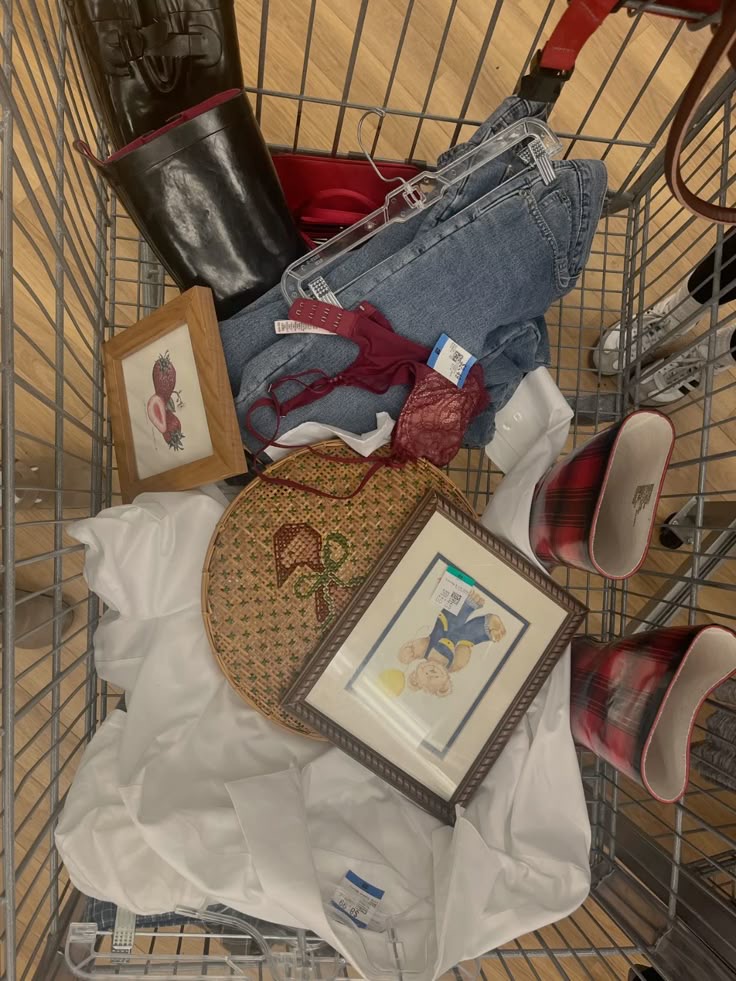
lessons in care, history, and intention: how my approach to consumption changed for good.
A few months ago, I went through a sort of awakening. It started with an overflowing closet I initially thought I could fit in my suitcases while I was moving, and the uncomfortable realization that most of what I owned I had either forgotten about, or had no real purpose whatsoever: clothes I never wore, decorative objects that didn’t have their place, piles of half-filled notebooks, way more pens that I actually used, and so much more.
Now, as most of you know, packing is a crisis. And during a crisis, you usually don’t have the time to pause and reorganize a dozen times. At least, that’s not the case for someone who gets anxious really easily, i.e. me. I only had one option, and it was to empty everything out and have 2 piles only: what I’m keeping, and what’s going. By the end of the day, I had filled several bags for charity, and continued doing so even after arriving home with the rest of the things I was able to finally fit in my suitcases.
I had done similar declutterings before, but this went further than that. It felt like waking up from a long, quiet spell – one where I’d just been buying out of habit, not actual desire. This time, this really bothered me. I didn’t like that behavior at all. I started wondering why I’d felt the need to own so much in the first place, when the things I actually valued enough to keep were of a much smaller percentage.
I came to this horrible conclusion: consumerism had quietly, but surely, shaped my life and habits. And did that send me down a rabbit hole! Unfortunately (but maybe fortunately) for you, I’m taking you down with me, and who knows, I might pass this on to you and we can all work towards healthier habits together, doesn’t that sound nice?
A-Tisket, A-Tasket, a Black Leather Jacket
We all have that one piece that is very dear to us, it becomes a staple of our personal style, and it’s the one we create outfits around instead of it being a mere added piece. To me, that piece is a black leather jacket I bought from a vintage shop in Milan last year–a place that smelled faintly of dust and cigarettes, where every hanger left behind felt like a fragment of that person’s story. That jacket fit me perfectly, and looking at it today, I don’t think I realize how much I actually wear it–how often it has been part of moments in my life. It’s safe to say it’s the one piece that has outlasted every fast-fashion piece I’d ever bought so far. I’ve worn it to airports, dinners, concerts, errands… and instead of falling apart, it has softened with time.
The example of this jacket shows two things that I think are very true:
1- How grounding it felt to choose something that had already existed, something I was continuing rather than purely consuming.
2- How it carried proof that quality and longevity can still be found in those types of pieces, that something built to last could also build attachment.
Therefore, armed with these two points, I make the case that there is a way to escape massively consuming, and that is by CONTINUING instead: choosing something to carry the object forward.
The seams of my jacket carried someone else’s history, a story that hadn’t ended yet because I chose to continue it. I don’t know about you, but I would dub this as very cool.
The Afterlife of Things
That idea alone has changed the way I see everything I own. When I buy something used–whether it’s a piece of clothing, a vinyl, a CD, a book–I feel like I’m keeping the object’s story alive, giving it another act instead of letting it disappear. And I think that approach has some sort of underlying satisfaction as well, especially in a world where most things are now designed to be temporary.
Modern consumer culture thrives on disposability. Look around you, clothes that last a handful of washes (I’ve had numerous white t-shirts turned yellow that can attest to that fact), gadgets that we change within a year (our phones), endless “new drops!” that feel old almost immediately. Everything is built for the short term, and for what? Quality that has diminished over the years? The result is a kind of amnesia: we forget to form attachments to the things around us (not in an obsessive way of course) because they’re not made to stay. So we buy and buy and buy, but rarely do we think of the space these things are occupying in our daily lives. And I’m just going to leave this here: Japanese professional organizer and consultant Marie Kondo was not wrong when she said this behavior and accumulation is a big part of our growing stress and anxieties in the day to day life, just saying.
Arguably, used things are different. A record that crackles because someone else played it, a book that bends because someone else read it… They carry memory, and we tend to think of them as objects with more meaning because of that. Aren’t we, as human beings, in constant search of meaning? Don’t you often wonder why a lot of us are obsessed with “vintage things”? Well, there you go. The dots are connecting, and I think this explains a lot.
When I think about the items I recently gave away, a few things come to mind. First, I am actually starting a cycle myself! I gave these pieces away to charity and second-hand stores, and now they might just be patiently waiting for someone else to pick them up like I picked up my leather jacket. Second, I realized how much I was straying away from the definition of ‘collection’ I have in my brain, and that instead of considering my “possessions”, if you will, as prized, they were simply abundant–and not in a good way. And third, I could not for the life of me remember one significant piece that I had previously owned, or even picture something I gave away from that huge pile of things. Whereas now, I can tell you exactly what’s in my closet, what’s in my drawers, what’s in my CD cabinet etc…
Less is more, people. Less is more.
Continuity as a Habit
The more I thought about the life of objects, the more I began reshaping my own habits around that idea. Starting to pay attention to how things entered my life was a start, but I started using other things to my advantage as well.
For instance, I’m a big fan of vinyls and CD’s. And not because I want to buy them just like that, but because I grew up with them in the house. Now, they only come home with me if they’ve already had a life elsewhere and if I don’t have that particular record. And that’s rare, because I have my uncle’s collection at my disposal–shelves upon shelves of every genre imaginable. There was nothing that man wouldn’t listen to. When I play his vinyls or CD’s, I already feel like I’m inheriting parts of him as a person right there. What more could I possibly need? It’d be a shame. These ones look and smell used. They remind me that music is always meant to be experienced, shared, and passed on, hence why I take such good care of them.
The same goes for clothes and accessories. Guess what keeps “coming back” in fashion terms? That’s right, our moms and grandmas’ clothing. Again, I don’t even have to look outside the house. I’ve begun wearing pieces that belonged to my mom, my aunt, and my grandmother–tops, jackets, scarves, handbags, jewelry… Things that were manufactured in a time where quality was at the top of the list. They fit in a way new things never could, not just physically but emotionally. There is something so beautiful about knowing the things I wear have lived entire lives before me, have been part of other moments, other versions of my family. They are part of those things we attribute value and meaning to, as I was explaining before. Their cycle therefore continues.
Even in small, everyday choices, I’ve become more conscious about excess. And I’ve realized how easy it actually came to me. By that I mean: I always make sure to finish what I already have before buying another–makeup, pens, highlighters, notebooks… It sounds trivial, but it truly changes the rhythm of consumption. You start to notice what you actually use, what you actually love. It’s not so overwhelming anymore, there’s a strange calm in it – in letting things run their course instead of rushing to constantly replace them just to feel the “new” element of it. You don’t cleanse your palate by buying a whole new set of colored pencils because some of them are used and don’t match the height of the others, trust me.
These habits, simple as they are, have made my space and mind quieter, something I’ve been craving recently. There’s less clutter, less guilt, and a sharper sense of appreciation for what remains. The environmental benefit matters too, of course, and cannot be ignored–less waste, more circulation. I’ve stopped seeing ownership as the endpoint and started seeing it as participation in something ongoing.
In a world that rewards novelty, choosing continuity feels radical — or at least intentional.
The Value of Remembering
Consumerism thrives on repetition disguised as originality — the same shapes, colors, and ideas rebranded each season as something new. It’s a system designed to make satisfaction brief and ownership fleeting. Things aren’t built to last; they’re built to be replaced. “New” becomes a synonym for “better,” and anything that stays too long begins to feel wrong, outdated, disposable.
That mindset sort of shapes the way we see value — not just in objects, but in time, attention, even identity. The culture of newness keeps us in motion but rarely in connection. It rewards impulse, not intimacy. Those habits I was just talking about (and many more that you can find!) interrupt that cycle. They slow it down. When you pick up a used record, a worn jacket, a passed-down piece of jewelry, you’re saying no to the idea that everything meaningful must be freshly made, that these objects you’re holding don’t just expire.
Apart from it being an environmental gesture, I argue that it’s a cultural one as well–kind of like a small rebellion against disposability. I truly think of the word “enough” now not as a limit, but a language–one that speaks to care, history, and intention. The bottom line is: owning fewer things doesn’t mean caring less; it means caring more deeply, I don’t make the rules!
Objects like my leather jacket — vinyls, CDs, clothes passed down from my family — have a story that doesn’t end with me. I am merely the next chapter. In wearing it, playing it, using it, I am choosing to continue a life rather than discard it.
Consumer culture functions on things that are designed to be replaced, forgotten, and forgotten again. But by preserving history and giving objects a second life, we create something richer: connection, memory, and intentionality. It’s no wonder researchers are fascinated with the study of cultural and societal memory. While the true forces of change — conflicts, migrations, cultural revolutions — shape the world, my own story is just a modest sketch, a personal blueprint in a far larger narrative.
When I think back to the piles of clothes and objects I gave away, I realize that letting go of the ephemeral made space for what matters. The jacket, the records, the inherited accessories — they are proof that things can outlast trends, algorithms, and the momentary urge to consume. And in letting these objects continue their stories, I’ve learned to continue mine with more intention, care, and patience.
By fear of being misunderstood, I want to say that outlasting consumerism isn’t about abandoning the material world; it’s about CHOOSING the objects, habits, and stories worth carrying forward from said world. Because let’s face it, abandoning it completely is not an option today. Therefore, it’s about slowing down, noticing what we truly value, and giving life to the things we love — so they, and we, endure.

 the back rows
Leave a comment