how two overlooked deities of Greek myth reveal the wisdom of cycles, duality, and balance.
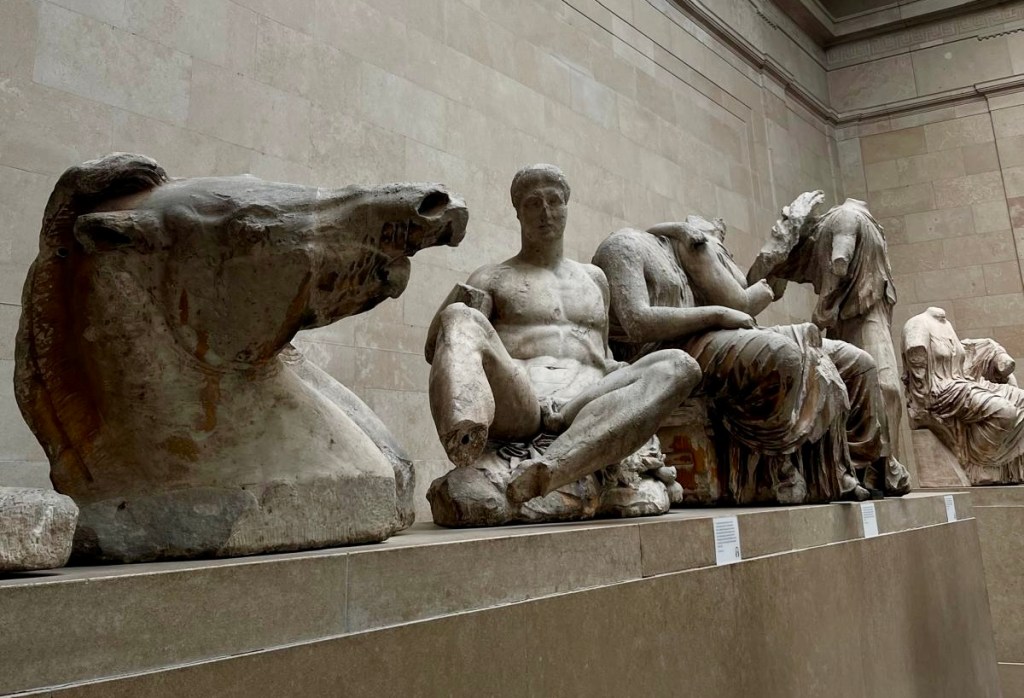
I was wandering through the Parthenon gallery of the British Museum — which covers a vast span of Greek history and artifacts — when I stopped in front of a series of statues from the East Pediment, depicting the birth of Athena. It was the first and only moment that truly called me to linger. Beside a statue of Dionysus — the Greek god of wine and festivity, among other things — stood the sculpted head of a horse. A brief label explained that the horse had once been part of a chariot belonging to Selene, sister of Helios. For some reason, those two names piqued my interest. I stayed in that section for a while, reading and researching the missing pieces housed in the Acropolis Museum in Athens: Helios, the sun god, rising in his golden chariot; and Selene, the moon goddess, descending into the sea.
It would have been easy to miss this fragment, tucked among other figures in a gallery somewhat removed from the main hall. And unlike Apollo and Artemis — whose names instantly evoke light, art, wilderness, and the moon — Helios and Selene felt strangely unfamiliar, as though their stories had dimmed over time.
I found myself asking: why didn’t I know their names? Why don’t we remember these figures as clearly? I was so drawn in by their story that my curiosity led me into deeper research. What I discovered was remarkable: though forgotten by many, Helios and Selene embody an ancient vision of cosmic balance — one that might be worth revisiting today.
The Forgotten Siblings
In the earliest days of Greek mythology, Helios and Selene were not Olympian gods (major gods of the Ancient Greek pantheon who resided on Mount Olympus such as Zeus, Poseidon, or Athena) but children of the titans Hyperion (the “High One”) and Theia (goddess of sight and radiance), which makes them siblings of Eos, the goddess of dawn. Together, the three formed a cosmic triad: dawn, day, and night.
Helios literally means “sun” in Greek. He was the very embodiment of the sun, sometimes also called “All-Seing Helios” because, as he daily traversed the sky on his four-horse golden chariot, he could observe all things. He is always shown as a handsome, radiant youth with a shining crown or halo that had twelve rays, symbolizing the twelve months of the year. He was responsible for bringing the sunlight and day to the world, and was a witness to oaths and truth—since nothing could be hidden from him. This is also why he was associated with sight and vision, a resemblance to his mother Theia.
Selene by contrast, which means “gleam” in Greek, was the personification of the moon—as she was sometimes also called Mene (meaning “Moon” in Greek). While she is not mentioned as often as her brother, she is said to be known for her beauty and radiant, soft glow. Portrayed as a luminous woman with a crescent moon crown, she drives a silver or white chariot pulled by two horses (sometimes oxen or mules). She was in charge of governing the night sky and the moon’s phases, which makes her role a bit more unique in that she is associated with cycles, time, fertility and months passing as tracked by lunar phases. In essence, she represents the changing and cyclical nature of life.
Fun fact: one of her famous myths is that she was in love with the mortal Endymion, a shepherd whom she put into eternal sleep so she could visit him every night.
Fun fact, one of her famous myths is that she was in love with the mortal Endymion, a shepherd whom she put into eternal sleep so she could visit him every night.
They seem pretty important, right? Yet for all their grandeur, Helios and Selene’s roles as cosmic forces were sort of overshadowed by the more anthropomorphic (having human characteristics) Olympians: Apollo, who took on the role of sun god—alongside his other domains of music, poetry, healing and archery— and Artemis, who became associated with the moon in addition to her attributes to chastity, wilderness and protection of young women. The key difference here is that Helios and Selene were not heroic figures with vivid myths, personalities, or dramas. They were, above all, the literal forces of nature they depicted—eternal, predictable, and indispensable. Whereas Apollo and Artemis’s respective solar and lunar aspects were more symbolic and cultural than cosmic.
And perhaps that is precisely why they were forgotten. In celebrating Apollo and Artemis, the gods of art and individuality, stories of ambition, conflict, and human-like drama were preserved. I argue that in letting Helios and Selene fade, we lose touch with something albeit quieter, yet equally vital: the source, the acceptance of cycles, of balance, of cosmic order larger than ourselves. And this may reveal less about them and more about us—about what we choose to value, and how our selective memory functions as a society.
Symbols of Duality and Cycles
If Helios and Selene seem quiet compared to their Olympian successors, it is because they speak not in stories but in patterns. Their significance lies less in mythic drama and more in what they embody: the eternal rhythm of existence. Helios is constant, rising and setting each day without fail, while Selene drifts through her lunar phases with more of a cyclical light. One is unchanging, the other endlessly changing—and together they form a balance that gives structure to time itself. Day is defined by the coming of night, just as night takes meaning in contrast with the day. Light without shadow blinds; shadow without light obscures. The Yin and the Yang all over again.
This duality is very rich metaphorically-speaking. We can think of Helios representing clarity, visibility, and conscious awareness, and Selene reflection, mystery, and the unconscious. But even further: masculine and feminine, rational and intuitive, fixed and fluid: their partnership reflects the Greeks’ deep recognition that life is not lived in absolutes but in the tension between opposites—and more about principle—a different interpretation to Apollo and Artemis’s characterization of the sun and the moon. Without Helios, there is no illumination; without Selene, no renewal. So it’s not just about the balance that sustains the cosmos, but it’s also the one that sustains ourselves as moral human beings. To live as moral human beings is to recognize both aspects within us: the light of reason and awareness, and the shadow of intuition and mystery.
What is talked about often reflects a broader pattern in how we value certain stories, certain forms of power, and certain ways of seeing the world. While other myths might offer some more human-like content, I think it’s important not to lose sight of the very principles they embody and that came first. Understanding what is missing from our collective memory opens the door to asking a deeper question: what do we lose when we forget Helios and Selene?
What We Overlook When We Overlook Them
For all their cosmic significance, Helios and Selene exist today mostly in fragments — a horse’s head here, a label there — and their names barely echo in popular culture. Their obscurity, however, carries a subtle warning about what our culture tends to prioritize. By elevating Apollo and Artemis — gods of artistry, heroism, and human-like drama — we celebrate the active, visible, and exceptional, while the steady, cyclical forces that govern time and balance fade from view. In many ways, forgetting Helios and Selene mirrors the modern world’s restless pace: a culture that glorifies progress, productivity, and constant activity, while undervaluing rest, reflection, and the quiet constancy of natural cycles. We design lives that chase the perpetual “day” of Helios while leaving little room for Selene’s restorative night. Yet just as the sun cannot shine without the moon’s retreat, our own lives lose depth and balance when we ignore the complementary forces of change and stability, activity and rest, awareness and intuition.
This cultural amnesia also reminds us of the subtle forms of power that rarely make the headlines: the unseen forces that shape our world, whatever they may be. The way I view it, Helios and Selene do not seek glory; they do not intervene in human quarrels or epic battles. And yet, without the idea of them, there is no day, no night, no rhythm to life. In essence, forgetting them goes further than a mere mythological lapse—it’s a metaphor in itself for how easily we can overlook the foundational, the constant, and the essential, basically.
The Museum as a Mirror
It is possible that, standing in front of the fragmented statues at the British Museum, I was attracted by that exact curious paradox: these characters, forgotten in myth yet immortalized in marble, felt more alive to me than some of their celebrated Olympian counterparts. The museum, in that sense, became a mirror. It reflected not only Ancient Greek understanding of the cosmos, but also our modern tendency to overlook certain aspects that may seem too quiet and set in stone.
And yet, another mirror emerges: the uneasy question of place. Should these figures be here at all? Helios and Selene once belonged to the Parthenon’s east pediment, woven seamlessly into the myth of Athena’s birth. Now, split between London and Athens, they survive in fragments, their narrative literally broken apart. Some might argue that the very act of removing and displaying them in a foreign museum is an act of colonization — history lifted from its context, separated from its home, and reassembled under a new story of ownership. For others, their presence here is a chance encounter, an opportunity for someone like me to stumble upon them, to be moved, and to remember what might otherwise remain unseen.
By lingering in that specific spot, I understood that museums do more than preserve artifacts; they preserve perspective, however positively or negatively shaped. The experience becomes almost meditative: in the stillness of stone, one can glimpse the cycles that govern life, and perhaps recognize how often we live oblivious to them. This is how the concept of museums invites reflection, and through that reflection, even ancient wisdom can still surprise us and illuminate the most modern of lives.
To remember Helios and Selene is to remember the necessity of duality, cycles, and balance. They remind us that life is sustained not by constant action alone, but by the interplay of opposites. Their absence from popular memory is telling, but their quiet survival in stone offers us a chance to recover the wisdom they once embodied.
For me, standing in that gallery, the encounter stirred something personal: an awareness of how easily I too move through life in haste, chasing the brilliance of Helios while neglecting Selene’s quieter call to pause, reflect, and renew. Awe turned into recognition — that the rhythm carved into myth is also the rhythm missing from so much of modern life, and often from my own.
Helios and Selene are not absent; they are simply easy to miss. And perhaps that is the final lesson: balance, like the statues themselves, reveals itself only when we slow down, when we notice what is too often overlooked. In remembering them, we remember that the cosmos — and our lives within it — is not only a stage for heroic exploits but a delicate, enduring dance of light and dark, motion and pause, action and reflection.

 the back rows
Leave a comment