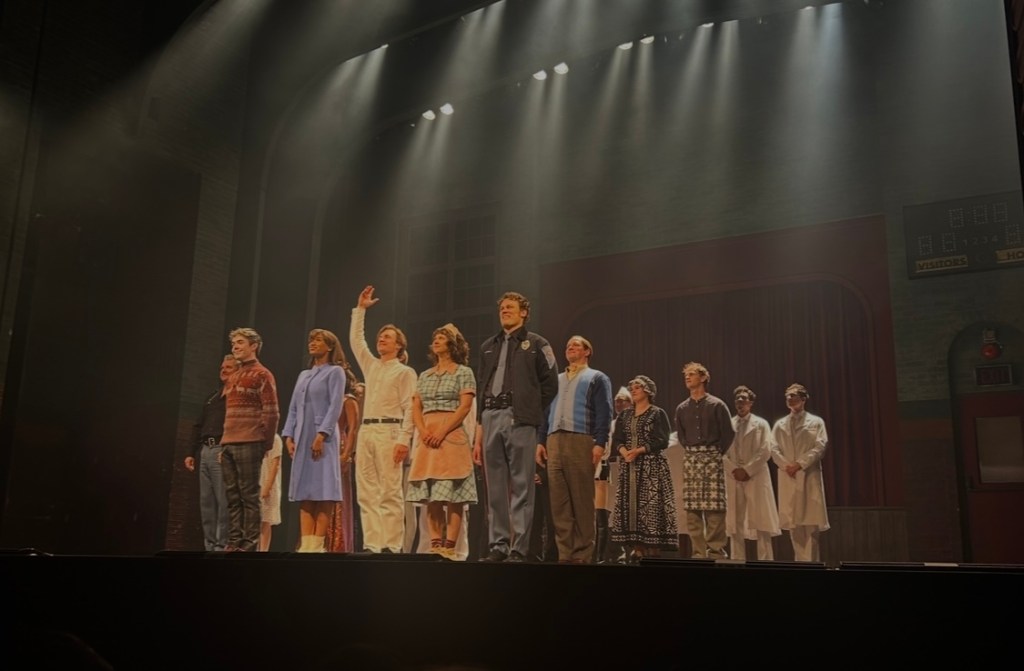
reviewing the theatrical spectacle and hidden depths of Stranger Things: The First Shadow.
I’m a very big fan of Stranger Things. When I say “fan,” I don’t necessarily mean it in just the fun, fictional character–obsessed way, but in the sense of genuine admiration for the show — its story, its production, and its craft. Stranger Things is essentially what made me fall in love with science-fiction as a genre, whether in books, films, or other media. And yes, some characters do stand out to me, and many of them I’m definitely “obsessed” with, if you will—in the sense that their very creation fascinates me the most.
This is going to be the first part in a series of posts I’d like to write about Stranger Things as a whole, since there is so much to unpack. Today, I’d like to start at the very beginning (no, not Season 1), with Stranger Things: The First Shadow.
When I was in London back in May of this year, I went to see the West End play at the Phoenix Theatre with a mix of excitement and curiosity, wondering how the show would be brought to the stage—a somewhat similar yet completely different realm, if you think about it. What made this more special, is I went completely by myself, an experience I highly recommend. It was strangely comforting and beautiful to share this with strangers who all came to see this play for the same reason I did. I even made a friend out of it at intermission, in one of those lovely interactions that happen with strangers once in a while!
overview & origins
Stranger Things: The First Shadow was written by Kate Trefry and is based on the original story by The Duffer Brothers, the creators of the show. The play officially opened in London in December 2023 and on Broadway in New York in April 2025. Set in 1959—24 years before the TV series begins in 1983—the play functions as a “missing chapter” in Hawkins, Indiana, which was already a site of strange occurrences long before Eleven’s appearance. Essentially, it shows how supernatural forces and government experiments began infiltrating Hawkins decades earlier, providing answers to questions raised in the series. If you’re familiar with the show, the play features Henry Creel, Bob Newby, Joyce Byers, Jim Hopper, and many other familiar faces from these characters’ generations—not in a fan-service, nostalgia-driven way, as many might have expected, but in a manner that genuinely expands the Stranger Things universe and makes sense when you reflect on the characters’ relationships and storylines in the TV series.
characters & performances
Other than new interesting additions, it was lovely to see younger versions of some characters in the play since I’d been so curious about their backstories, especially Joyce and Hopper—and the play did not disappoint. I will list my observations here alongside the actors’ names for each character on the night I went to see the play, and they truly deserve the credit:
Henry Creel (played by Harry Ames):
I have to commend Harry Ames for his portrayal of Henry—especially since I later found out he was the understudy for the role—because it was astonishing. Having watched the show several times, I can imagine that it’s hard to discern between the actor’s performance on TV and the actual character’s personality for someone that’s supposed to follow in those footsteps, especially with characters like Henry. Except that Harry portrayed him with such fragile humanity, and at the same time with his escalating obsession with power, that it made his descent more layered rather than purely villainous. Henry is not just monstrous; he is alienated and yearning for connection, and his character’s centrality gave more emotional weight to his arc in the TV series. Whenever he was in pain or angry, it was heavily felt in the theater, and that’s why I thought Harry Ames’s performance was that good.
Patty Newby (played by Rhianna Dorris):
I was surprised to find that Rhianna Dorris is also the understudy for the role of Patty Newby, and actually plays Sue Anderson in the main cast! Which made me like her even more, because the two characters are quite different, and while I haven’t seen her perform as Sue Anderson that night, I thought she was great as Patty. She provided the exact vibrant contrast to Henry—tender yet strong—and she’s a poignant connection amid his turmoil. Patty is Bob’a adopted sister (which we didn’t know about in the show!) and becomes Henry’s love interest—the sole balance between his humanity and monstrosity—also being an outsider seeking belonging. Rhianna’s performance was very emotional, and she actually shone on stage, especially when she was opposite Harry.
Joyce Maldonado/Byers (played by Jessica Rhodes):
Joyce is my second favorite character in Stranger Things, and Jessica Rhodes made sure it stayed that way. I absolutely loved her energy on stage and her chemistry with other characters. I also loved how she echoed Joyce’s imaginative and headstrong personality that we see glimpses of in the show—a bit tamer with age (but not so much!)—and perfectly defines her relentless drive as a mother later on. She was also extremely funny and witty, especially in her interactions with Hopper, again very similar to the banter in the show. While also being somewhat of an outsider, she was the only bold one of them, and forced her way in instead of sitting around and wondering how to do so.
Jim Hopper (played by George Smale):
Hopper is my favorite character, and George Smale was my favorite performance. I know I said that they are somewhat of their own people and don’t necessarily have to be associated with the characters of the show, but not only is George a younger version of Jim Hopper, he also happens to be a younger version of David Harbour (who plays Jim Hopper on the show). He absolutely nailed the character, and I noticed it with everything: voice, mannerism, movement, personality… Being a high schooler here, he is reeling from his father’s war trauma and small-town frustrations—an intriguing backstory for the character—and which explains so much about his cynicism and rebelliousness here and in the show once he becomes the town’s chief of police. It was also so sweet to see his character cling to Joyce, showing a glimpse of his emotions in spite of his gruff personality traits.
Bob Newby (played by Callum Maxwell):
Callum Maxwell was an ideal choice to play Bob Newby. Bob is sweetly nerdy, and fascinated by science fiction and technology since his youth—as we see him experiment with radios and broadcasting (a main source of narration in the play). His optimism and kindness remain consistent with the character played by Sean Astin we meet in season 2 of the show, and together with Joyce (whom he has a crush on since the beginning) and Hopper (whom he develops an unlikely friendship with), he forms a youthful investigative trio that serves as a sort of prototype for the show’s kids later on.
Dr. Brenner (played by Luke Mullins):
Played by Luke Mullins—who also did a great job—Brenner is as cold and menacing as ever. We don’t see him much, but when we do, he establishes early iterations of the experimental programs that later produce Eleven and the numbered children, linking Henry’s abilities to Cold War-era obsessions with psychic warfare and clandestine government projects.
other characters:
While these are the main characters with which the story unfolds, it was so nice to see other familiar faces such as Ted and Karen Wheeler (Mike’s parents), Alan Munson (Eddie’s father), the Sinclairs or the Hendersons, Henry’s parents (Victor and Virginia Creel) and more.
main storyline & subplots
A prequel set in 1959 Hawkins, Indiana, Stranger Things: The First Shadow explores the origin of Henry Creel (whom we know as Vecna or 001) and the emergence of this dark powers. The core narrative follows Henry’s early life with his family, his growing psychic abilities, and the ominous events that begin to fall on the town—mysteriously dying pets, unexplained disappearances, and an experiment gone wrong that opens a path to the Upside Down, all a foundation for the general storyline. Which is why, even if you haven’t seen the show, you can start with the play.
Beyond the surface narrative, the play engages with so many deeper allegorical themes (echoes of war, familiar trauma, yearning for normalcy), and with the intertwining subplots, creates a compelling and multidimensional depiction of Hawkins and its extraordinary events. I won’t detail much as the experience of watching it live is much too precious for me to spoil everything, but here are some subplots that tie into the the main one that I loved seeing come to life:
The Play-withing-a-play: this is one of my favorite aspects of theater when well executed, and in this case, we’ve got Joyce organizing a school production within the play itself—and which the story starts to revolve around. This meta-theatrical device (similar to Hamlet’s structure) is a clever narrative misdirection. Not only does it make us question where the line between theatre and reality ends (both in the play and outside of it), but it also highlights Joyce’s ingenuity and determination—which tie into the investigation she undergoes on the side—traits that will define her adult character in the series.
Young Investigators: the teen versions of Hopper, Joyce and Bob form a detective-like trio and navigate mysteries around town, exactly the same as they do more than 20 years later in the show. I loved seeing their interactions, which were both practical and emotional: Hopper’s waywardness tempered by Joyce’s problem-solving, and Bob’s optimism providing grounding and hope. They had a lot of going back and forth with the dialogue and jokes, it was very entertaining.
Interpersonal dynamics: Henry’s tentative romance with Patty has a big emotional core for both characters. I noticed how much Patty functioned as a mirror for Henry, reflecting both the possibilities of connection and the consequences of rejection. And what I was most excited to see: Joyce and Hopper’s hints of them being more than friends. How well this was showed! It is obvious now more than ever how much they liked each other before the show, and why everyone circulated rumors that they had a thing for each other. Little moments of tension when they were alone made me giggle like a teenager reading fan fiction, and the “almost something” shattered by Hopper having to enlist in the army and Lonnie Byers refusing to let Joyce go was so frustrating! These tiny moments left us wanting so much more, while at the same time providing the perfect base for the later emotional depth of their adult selves.
Connection to the Stranger Things universe: The First Shadow expands the mythology of Hawkins by revealing that the Upside Down’s presence began decades before Eleven opened a gate. The play of course foreshadows Vecna’s rise—and while I have no clue what is coming next in the story— is described by The Duffer Brothers as “essential viewing” for the upcoming season 5 (set to premiere in November 2025), and goes further by emphasizing a generational cycle of trauma and legacy that makes Hawkins the epicenter of supernatural invasion.
theatrical elements & stagecraft
I can’t compliment the production’s stagecraft enough—which is a spectacle in itself. I couldn’t have pictured science-fiction and special effects to be more immersive than they were, from electricity sparks, to split screens, to video introductions, to audience participation with the lab workers walking between rows at intermission. I had completely forgotten about everything else during the play, I did not touch my phone, I did not check the time, and I was petrified. Completely and fully immersed, but petrified. And that’s why it’s such a success to me as well, as theatrical elements are crucial to deliver the desired feeling.
The revolving set—designed by Miriam Buether—completely transformed Hawkins into school corridors, attics, labs and dreamscapes, giving the effect of cinematic cuts on stage, and paired perfectly with Brigitte Reiffenstuel’s costume designs for the era. Illusions by Jamie Harrison and Chris Fisher push theatrical boundaries with levitations, grotesque transformations, suspended bodies, culminating in the breathtaking Mind Flayer puppet that looms over the audience (I was sitting in the third row, so you can imagine the scare when it reached us from the side). Flames, snow, spectral landscapes blended with practical staging to create that cinematic depth.
Jon Clark—who was in charge of lighting design—did such a good job in amplifying horror and nostalgia through neon glows, sudden plunges into darkness, torch beams and comic-book style spotlights. Paul Arditti and D.J. Walde’s sound and score layered static, hisses, orchestral stings and that synth-driven soundtrack that the show uses and absolutely pulled off the spine-tingling and shiver-inducing sensory punch.
dialogue & writing
Aside from a good production and performances, dialogue and writing are what make a play a hit or miss. In this case, a hit! The script balances adolescent wit, ominous horror, and heartfelt exchanges in a way that captures the cadence of 1959 without losing the signature Stranger Things tone. As mentioned before, the banter between Hopper, Joyce and Bob offers humor and relatability, while Henry and Patty’s exchanges give emotional depth to the story’s tragic trajectory. Cultural and era references are also very well included—with talk of reminiscence of war for example, or play and novel references.
I thought the writing was very fluid, and didn’t feel overly theatrical or veering towards musical. There were quick scene shifts that made the plot engaging to watch—kind of like cinematic editing—humor cuts through moments of dread that were well places, and a good deal of reflective pauses that ground the narrative in the middle of chaos. I’d read that this brisk pace can sometimes be overwhelming for the audience, but I honestly thought that the (immediate) fast-moving structure felt thrilling and cinematic, sustaining suspense and energy across the runtime, and completely pulled me out of the real world (as the Stranger Things world so often does).
Overall, I had some pretty high expectations from the beginning—maybe a little biased because I knew The Duffer Brothers were involved and I trust their writing—but it’s safe to say that they were met as well as exceeded. You don’t have to be a hardcore fan of Stranger Things to watch the play (because you will become one after). Regardless, it’s an impressive piece of work theatrically speaking, and a good introduction to the show itself—with a cast that works hard to do this every night for several months. I had always liked theater, and it had been a while since I saw a play that left me bewildered and in adoration of art—a feeling I wholeheartedly welcome every time—so I’m glad to have seen it and be able to talk about it.
My take on Stranger Things to be continued…


 the back rows
Leave a reply to Found Families Under Fire: Protectiveness as Love in Stranger Things Season 2 – The Back Rows Cancel reply