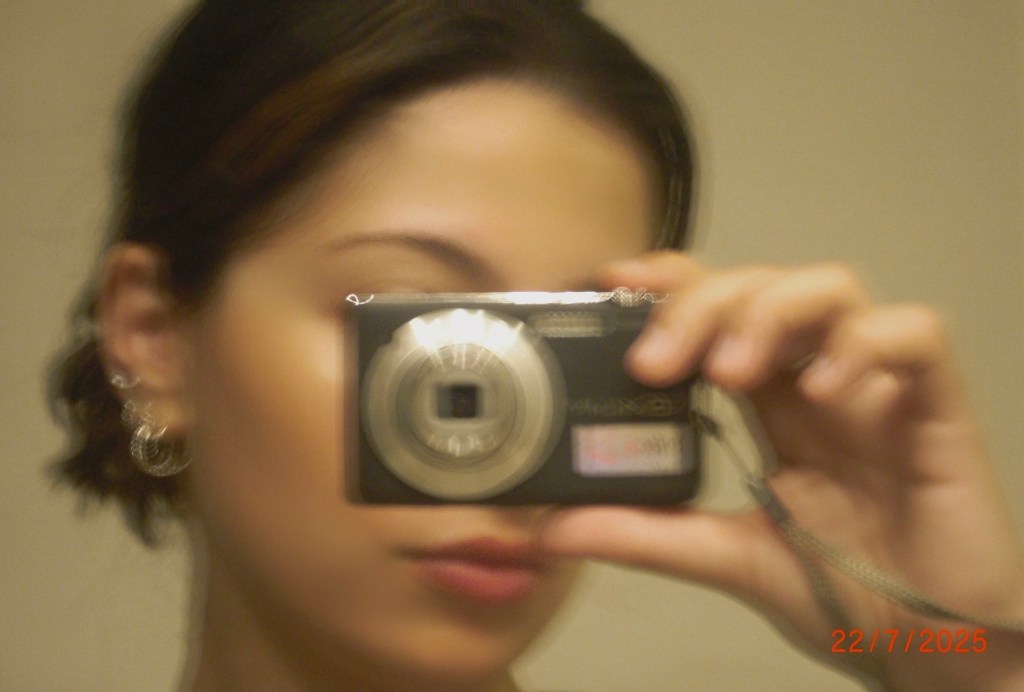
on looking too much: mirrors, cameras, and the slow distortion of the self.
Catching our reflection in a window or mirror, we often pause without knowing why. We replay a short video, a selfie, a recording. Not to remember, but to check: to confirm what we did, how we moved, how we sounded. Did it match the image we hold of ourselves? Or the one we hope others will hold? We yearn to be able to see ourselves from an omniscient point of view, to be able to go outside of our bodies and judge from there.
There is a quiet pull in the act of seeing, a strange gravity in recognition. We return to our own image without thinking, without deciding, as if the self were something fragile that needed to be checked on, revisited, reassured. The looking repeats. And with each repetition, the act feels less like reflection and more like routine.
It isn’t a question of mirrors versus cameras, or of one being more honest than the other. The question goes deeper: what happens when a self is constantly returned to itself as an image? When the act of seeing oneself becomes a ritual, a compulsion we cannot break? When the self learns to exist not in experience, but in observation?
This is the uneasy habit of watching oneself.
the image at the center of the Self
Jacques Lacan, French psychoanalyst and psychiatrist, explains that the ego is, at its core, an image. We do not first encounter ourselves as stable, coherent beings. We encounter ourselves as something outlined, bounded, and recognizable. The image comes before the feeling of unity in a person.
The mirror stage is a developmental milestone in childhood – when we see ourselves for the first time. But from that moment on, it’s an ongoing condition. In adulthood, we continue to meet ourselves in images, returning to reflections, recordings, photographs… The self remains something we recognize from the outside first, and only later – if at all – from within.
Why is an image such a seductive concept? Because it’s coherent. Because we can make it coherent. We can control it. Where experience is messy, contradictory, unfinished, the image offers a whole. The trouble begins when the image stops being merely formative, and starts to feel authoritative. When it no longer helps the self come into being, but begins to dictate what the self can or should be. When it controls us.
from reflection to surveillance
At first, self-recognition feels harmless. A glance in the mirror to orient ourselves, a brief look to adjust a detail. But something shifts the more looking becomes repetitive. That glance turns into an in-depth check. That in-depth check turns into a full-on examination. That examination turns into a part of a daily routine. With repetition, looking stops clarifying and starts compressing. The self is reduced to what can be seen at a glance, assessed quickly, corrected if necessary. Subtleties flatten. Contradictions are smoothed over. The richness of experience gives way to a narrower question: How does this look?
In his book Being and Nothingness (L’Être et le néant), Jean-Paul Sartre makes one of the most important distinctions about the human nature: “being-for-itself” (pour soi), which represents human consciousness – free, undefined, and constantly making itself through choices – and “being-for-others” (pour autrui), which is the dimension of existence where the self is objectified, defined, and judged by the gaze of another. Obsessive self-looking pulls the self away from the former and toward the latter, where one begins to experience oneself as an object, even in solitude.
The gaze starts to be in constant state of evaluation, and the self molds itself to move, speak, and feel under its pressure. You are in a state where you feel constantly watched. And if you’re not watched, you’re visible. Still exposed. Surveilled. And the odd part is: it’s by yourself, and yourself only.
watching the Self become an image
Mirror and cameras, our two main points of image accessibility, intensify this split in different ways – but ultimately have the same result.
The mirror interrupts. It pulls the self out of a flow of experience and redirects attention toward appearance, posture, expression, all happening in real time – hence why we can spend hours in front of it.
The camera works more slowly, but more decisively. It reaches backward in time, rewriting what was lived by offering an image that can erase a memory. What mattered in the moment becomes secondary to how it later appears. In one of my favorite books on photography Camera Lucida, literary theorist Roland Barthes names this quiet force when he describes the photograph as proof: the “this has been” aspect of it. The image does not argue. It simply exists, and in existing, it overrules. Memory, by contrast, feels unstable – too emotional, too incomplete, too easily revised. The image appears to stand outside this fragility, offering itself as something firmer, more trustworthy. The self begins to migrate from experience into representation, from what was felt to what can be shown.
If we move away from a mirror, we won’t see our reflection. But we can carry a photograph with us everywhere we go, and we can look at it longer and whenever we want. Since it doesn’t capture what we truly look like (neither does the mirror, or so they say), it can feel like we’re looking at a different version. Sartre describes the moment of being seen as a freezing of freedom. Under the gaze of another, the self hardens into something fixed, something defined. The camera extends this freezing indefinitely. The moment does not pass. It can be replayed, EDITED, reexamined, judged again and again.
Self-consciousness, insecurity, they grow louder. Experience begins to shape itself in advance, anticipating its own image. One lives not only through moments, but toward their capture. And slowly, almost imperceptibly, the balance shifts: the more the self is watched, the less it is lived.
what remains unseen
Distortion does not depend on deception. The image may be accurate. It may capture exactly what was there. But accuracy is not the same as truth. Something can be faithfully represented and still fail to contain what mattered.
The ego clings to the image even as it narrows it, choosing recognizability over complexity. The image offers a stable surface, and the self accepts the trade, often without noticing what is being given up.
Not everything wants to be clarified. I don’t think everything needs to be clarified. Not everything becomes truer when it is brought into the light. Contradiction, for one, resists being captured. So does privacy, and the vague, unarticulated feelings that have not yet learned how to name themselves.
To look less doesn’t necessarily mean to know less. It might mean allowing the self to be something other than just an image, to trust sensation over confirmation, presence over proof. It would mean loosening that habit of returning, the quiet urge to check, to verify, to see oneself from the outside.
Whether such a self is still possible remains an open question. Can a self exist without proof? Without being recorded, reflected, confirmed? Or has visibility become so central that to disappear from view is to disappear altogether?
I fall into that trap sometimes myself. I talk about a shift in perception, but there is a bigger shift in feeling I do not like when I know I am watching myself too much. I do like lingering in front of mirrors until all of my “imperfections” stand out. I do not like exposing myself to my camera too much. Because I sometimes wonder how I can find such beauty and attraction in something or someone I take a picture of, but have to look hard and adjust too much to find that in my own picture. I don’t know what my brain does at that moment, and this is how I know I lose control. So, I pull away for a while.
It is a difficult habit to break the way the world is going and we are constantly shoved in front of our own reflections. But I don’t think we’ve paused enough and thought that perhaps the self was never meant to be seen so often, or so clearly, or so completely. And whatever the self is, it may not survive being asked to show itself so often.

 the back rows
Leave a comment