a meditation on ritual, absence and gestures that refuse to disappear.
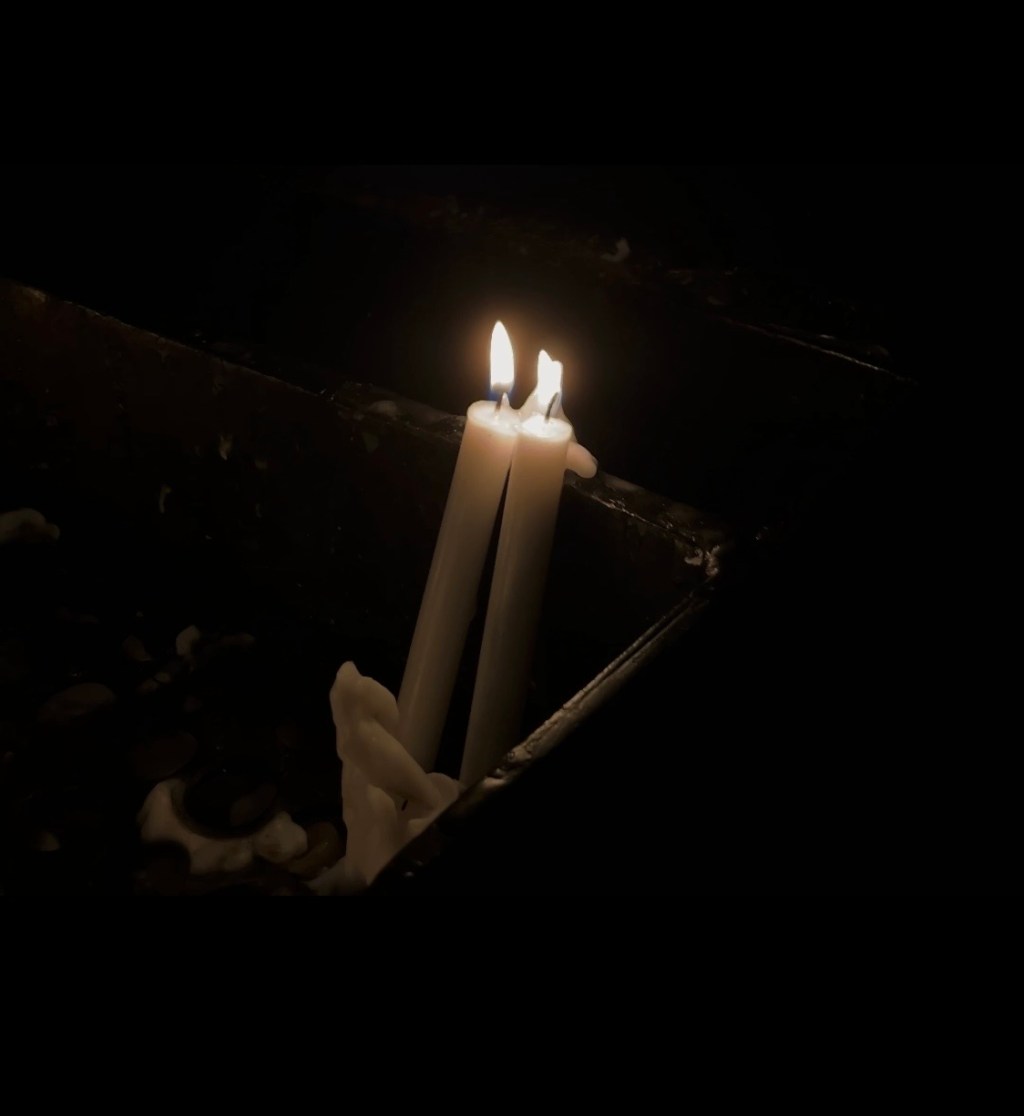
I was visiting a church the other day. Not your typical church, it was the grotto of Our Lady of Awaiting in Maghdoucheh, the village I come from in the south of Lebanon. It’s already a tight space, where only few people can enter at the same time. On my way out, that’s when I noticed it – not in a dramatic way, but almost incidentally. Off to the side, away from the pews, there is a stand set for candles, some newly lit, others already bent and shortened by time. It’s always been there, and I’ve always stopped in front of it to light a candle myself, but this time, I really lingered.
Lighting a candle in a church is a small, inherited ritual, one that has been repeated for centuries. In Christian tradition, the candle stands in for a prayer: something offered without words. My grandmother used to tell me: “light me a candle when you go.” The light is meant to signify presence – of faith, of vigilance, of a watchfulness that continues even when the person who lit it has moved on. The flame remains after you leave, kind of doing its quiet work on your behalf.
I stood there long enough to understand the shape of the gesture. You take a candle, you light it from another flame, you place it among the others. No explanation is required, really. The meaning is already agreed upon. And I never thought of it just standing there when I left, or the fact that it will eventually melt away, and it will look like some of the ones I’ve seen myself that were lit hours or a day ago. Until now.
A Simple Gesture
The steps are so simple and already known, even if I couldn’t tell you where I had learned them, where my mother learned them, where my grandmother learned them… Light the wick. Wait for it to steady. Find an open place among the others. Set it down carefully. There is a quiet competence to it, the kind that comes from having seen something done many times before.
Once lit, the candle does very little. Its flame is narrow and unambitious, barely altering the light in the room. The corners of the church remain dark. Nothing really shifts in any visible or measurable way. The gesture, taken on its own, borders on ineffectual. It doesn’t insist on being noticed. And yet, people continue to gravitate towards the candle stand and light them.
One after another, flames multiply quietly along the stand, each one requiring a moment of attention, a pause, a willingness to perform an act that doesn’t necessarily promise a resolution. I don’t think any of us wait for a result or proof. The effort is made anyway, not because it solves anything, but perhaps because it is the only tangible action that can be associated with hope. There is something beautiful about the fact that the ritual is somehow shared with other people’s worries or prayers, and to light our own candle, we must sometimes share the flame of another, and so on. It feels like the candles become a manifestation of us connecting with others, and in a language we cannot understand. On that one visit, I even noticed two candles at the edge of the stand leaning on one other as they burned. It was a small, almost accidental image, but a generous one – suggesting how easily we recognize the need to share weight, even when no words are exchanged.
The Symbol of a Candle
Candles in churches are rarely lit for what is present. More often, they stand in for someone or something elsewhere – someone absent, unreachable, or unnamed. The flame marks a distance, and it occupies a space where a person, a certainty, or a resolution cannot.
In that way, a candle becomes a container. It holds what is quite difficult to carry for long: grief without a clear object, hope without a timeline, fading memories that don’t know where to go. It can also hold unfinished thoughts – the kind that do not form into prayers, the kind that trail off before they become sentences. The flame of a candle doesn’t require clarity, it simply accepts whatever is placed into it without asking to be defined.
Left behind on the stand, the candle continues to burn in our place, making visible what would otherwise remain internal and unexpressed. For a time, at least, something stands there on our behalf, quietly bearing witness to the fact that a thought occurred, that an absence was noticed, that it mattered enough to be marked.
Ritual as a Vessel
The ritual we know as an explanation of belief becomes a structure built to hold what cannot be explained. You can look at it from a theological point of view or not, it functions as a vessel. The meaning does not necessarily have to be settled in advance. The ritual makes room for it anyway.
Candle lighting also comes with a moment of stillness, and the trust that the small act is sufficient. No one expects anything else from you at that moment, and it is a rare permission elsewhere. You can ask anything you want from it, or ask nothing at all and simply let it exist and be there. Whatever you do, this action legitimizes quiet intention. Within the ritual, there is no pressure to translate feeling into language or to arrive at a conclusion. The gesture stands on its own, already recognized, already allowed.
So maybe, the ritual absorbs what is otherwise difficult to carry for us. It holds meaning without insisting on clarity, and faith without requiring certainty. What began as a traditional practice becomes something more accommodating: a human framework for acknowledging what exceeds explanation, and for doing so without needing to resolve it.
The flame then continues on its own, indifferent to whether it is observed. It does not need supervision or acknowledgment. It will burn for as long as it burns, and then it will go out, regardless of your presence. There is a quiet humility in that arrangement – a recognition that the gesture was never meant to be sustained by attention.
The stands where candles are lit are always depicted as an open space. Nothing separates my candle from the next person’s. We all stand at the same place and allow ourselves to pause for a short while. This person might be asking for protection, that person might be wishing for joy. One another person could just be doing it because they saw everyone else do it. In that brief pause, we are present with one another, even if only in proximity, and never entirely alone.

 the back rows
Leave a comment