looking at the second season’s portrayal of care, control, and the emotional cost of keeping others safe.
Season 2 of Stranger Things was always the one least talked about from what I’ve seen – and I include myself in this. It seems quieter, but even scarier than the first. This time, it’s not about the crisis; it’s about the aftermath of the crisis. It is the turning point in the series, because it is the first and only time where we ask the question most stories skip: What happens when you survive the monster, but the monster doesn’t leave you? After that, we’re in it too much. We won’t ask this again, as we become used to it. So, it’s time to talk about Season 2 a bit more.
In my piece on The First Shadow and in my article on Season 1, I explored how children stepped into roles adults couldn’t fill, and how adults carried traumas they were barely able to face. Well, Season 2 continues that emotional lineage, but it shifts the lens. Not only is the darkness no longer just in the woods or the walls of the Byers’ home – but it’s time for the adults to reclaim their role of protectors.
This is the season where what we love to see as a found family stops being an ideal and becomes a test, for every single character on the show. Love becomes entangled with fear, protectiveness must curdle into control, all while characters renegotiate their relationships and their own pain. How do you protect the people you love when protection seems out of your control? What does family mean when trauma blurs the line between care and control? These questions are what make this season’s tone look softer and more interiorized on the outside, but really, emotionally messier on the inside.
the Byers: when home becomes a hospital
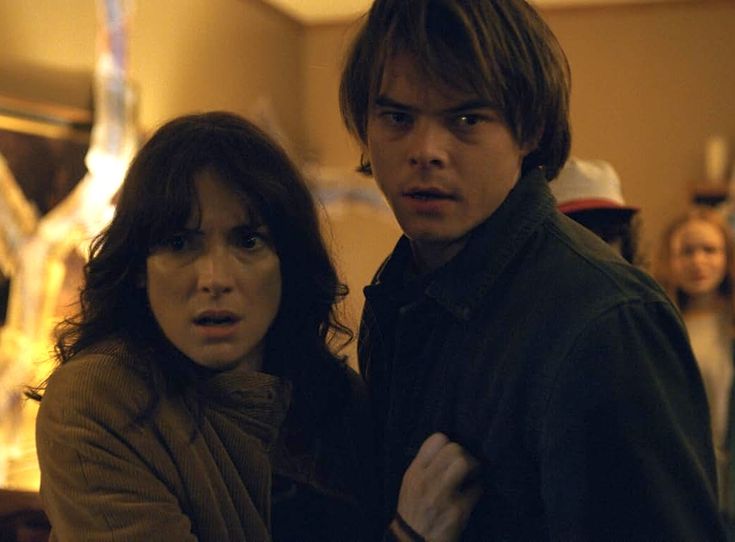
If you watch Stranger Things, the clearest thing is the fact that the Byers family (Joyce, Jonathan, and Will) is the most heavily affected circle in the show. After fighting to reclaim their home in Season 1, Season 2 is harsh on them because it shows what it means to live inside one that still feels infected. The Byers house is the emotional nucleus of the season – ruled by vigilance and grinding fear, as opposed to chaos this time.
Joyce is no longer frantic. She’s calmed down. She’s hyper-focused, observant, meticulous – a HUGE difference with her character in Season 1. As a mother, her protectiveness becomes almost clinical: temperature checks, doctor visits, routines… All of this without overreacting, just adapting. Her love has transformed into a survival strategy, because none of her children are capable of doing so at that moment. She also categorically refuses to let anyone minimize Will’s symptoms ever again. The town may want normalcy, but Joyce is someone who has always been (as we’ve seen in the play) keen on refusing to pretend everything is fine and safe just to make others comfortable.
Jonathan steps deeper into responsibility, and still fills the small emotional spaces his mother can’t always hold. His character has always been gentler, quieter, and his protectiveness mirrors that – hovering in doorways, watching for shifts in Will’s expression, ready to step in without ever announcing himself. Jonathan becomes the buffer between Will and the world, and sometimes between Will and Joyce. He knows things are not okay, but his love is resignation and determination fused together: he will make the world soft for Will whenever he can.
And finally, we have Will. Will is home, but not safe. Physically present, yet emotionally threatened by something still reaching for him. He becomes a child who performs “being okay” to spare the people he loves. Smiles that tremble at the edges, reassurances that don’t quite land. Noah Schnapp is phenomenal as a 12 year old playing Will, making us completely feel with him throughout this season especially. The family orbits Will at all times, and so do we. They’re trying to shield him from something none of them can fully understand. It’s important to note this, because he isn’t just recovering from something the remedy for was simple or medical; he’s carrying the weight of everyone else’s fear of the unknown, which cannot ever help him.
This chapter of the story grounds the emotional thesis of Season 2: protection always has a cost. The Byers’ love for each other is fierce, but it is shaped by trauma – trauma that alters how they see one another, how they breathe in the same room, and how they hope.
Hopper & Eleven: love as shelter, love as lock
Hopper and Eleven are perhaps the most complicated parent-child dynamic of Season 2. Their relationship is built on two people who have already lost too much, have a big age-gap, and are essentially starting from scratch. If the Byers represent love as vigilance, Hopper and Eleven represent love as contradiction – fierce, protective, and deeply wounded.
Hopper parents from a place of fear, not stability. Every choice he makes is dictated by the terror of losing another daughter, and that fear turns his love into something rigid and desperate. He locks Eleven in the cabin, hides her from the world, lies to her “for her own good”… it’s textbook. On paper, these are indeed actions of protection. In practice, they are the actions of a man still shaped by grief, and who believes that safety is something you enforce, not something you nurture. He doesn’t know better, he becomes the very thing he fears: a cage. He wants to save her so badly, but he never asks what she needs to feel saved.
Eleven, meanwhile, loves Hopper fiercely – something she is discovering and is getting attached too. Pretty normal, since she never got to experience it before. Her love manifests through longing and defiance. She doesn’t want to escape him – she wants to escape confinement, the thing he supposedly saved her from in the first place! Eleven is a wounded child craving connection, a family, a home – not a shelter built out of secrecy. It’s hard to see her anger, but it’s entirely justified. We are talking about a child – and no ordinary child at that – with a growing sense of self, fighting for the right to breathe on her own terms. Hopper misunderstands her rebellion as rejection, when it’s actually just an assertion of who she is becoming.
Their bond is deeply emotional, but neither knows how to voice their pain. Hopper is terrified of saying the wrong thing; Eleven is tired of being told nothing. They protect each other through silence, and that silence becomes the space where resentment grows. Their explosive argument in the cabin is one of the season’s most emotional scenes. Hopper’s shout – “I protect and I feed and I teach!” – is not only his worldview but his flaw distilled. Protection, to him, is something you impose. Eleven’s telekinetic outburst is the emotional mirror: a child demanding freedom, refusing to shrink herself to fit inside someone else’s fear. The scene is not just two people yelling at each other – it’s two forms of trauma colliding inside the small space they’re trying to call home.
This relationship is the clearest embodiment of Season 2’s thesis: found family is beautiful, but it is also painfully complicated. Hopper and Eleven mirror the themes introduced in The First Shadow and Season 1 – adults trying to protect children while carrying trauma they’ve never learned to untangle.
Mike, Lucas, Dustin & Max: a family that must learn to grow
There is something very bittersweet about the changes happening to the children who call themselves the Party (Mike, Lucas, Dustin & Max, and Will of course, but the focus here is on them since Will has a different arc). Their arcs offer a wider-angle lens: what happens when childhood friendships reach the point where they must evolve. Season 2 is the moment the boys stop being a single unit and start becoming individual people – carrying fears, loyalties, and desires that don’t always align – but still fighting to keep their club intact.
Mike channels his unresolved grief for Eleven directly into protecting Will. It is instinctive: he lost someone he loved, so he refuses to lose someone else. But that protectiveness creates a delicate imbalance. Mike also hovers, watches, and worries. Will, meanwhile, feels the weight of being the kid everyone is scared to lose again. Their bond becomes a reflection of Season 2’s central tension: love shaped by fear can feel like tenderness or pressure depending on which side of it you’re standing.
Lucas, perhaps more than any of the boys, grows in emotional maturity this season, and it shows with his interest in Max. He works to earn her trust, listens when she pulls back, pays attention to the small details of her discomfort – a very innocent and sweet behavior coming after asking his father how he makes his mother happy. Max’s guardedness is shaped by instability she never names aloud – Billy’s volatility, constant displacement, the ache of not belonging anywhere yet. While her character is still being introduced and overshadowed by other subplots, she finds the first hints of a different kind of safety with Lucas, a key aspect of her character development later on.
Dustin’s storyline cuts differently, and is perhaps my favorite. Not just in Season 2, but in later ones as well. His desire for connection – to be seen, to be special – leads him to keep Dart (a demogorgon) a secret long after he knows he shouldn’t. Many might interpret this as stupidity, but it’s not; it’s loneliness. Clear as day loneliness. Dustin’s arc is about what happens when belonging feels fragile. When the group begins shifting around him – Lucas with Max, Mike consumed by Will – Dustin reaches out for something that makes him feel chosen. Dart becomes the stand-in for a friendship he worries is slipping, and later on, Steve steps in and changes his life completely.
In a season defined by the strain of love, the Party’s journey expands the “found family” theme into adolescence, which is where the trope thrives. It explores how friendships evolve when childhood ends, and that growing up isn’t just about facing monsters in this case – it’s about negotiating the shifting ground between the people you care about
Nancy, Jonathan & Steve: responsibility, growth, and the shifting shape of care
The teen storyline of Season 2 is often mislabeled as a love triangle, but the emotional core is far richer than romantic tension. Nancy, Jonathan, and Steve represent a transitional stage of “found family” – not children and not yet adults, but young people beginning to choose who they feel responsible for. Their arcs explore what care looks like when you’re in the middle of defining the person you want to become.
What happened to her friend Barb in Season 1 completely haunts Nancy, not just emotionally but morally. That’s why her protectiveness doesn’t manifest as nurturing, it manifests as accountability. Nancy is unrecognizable in Season 2. There is a big shift from her character in the first season, and it is too evident. Her survivor’s guilt transforms into a fierce, almost adult determination to expose the truth. From reactive grief to purposeful justice – her version of “care” is making sure Barb’s story isn’t erased the way so many losses in Hawkins have been. That’s why we see her being there for Jonathan and Will with so much determination and courage. On the other hand, Jonathan’s support of Nancy isn’t solely driven by romance – it’s driven by recognition and relatability. Both of them carry heavy burdens: Nancy loses Barb, and Jonathan nearly loses Will (twice) in unfathomable ways. They understand the cost of silence, the weight of responsibility, the pressure of being the person who sees the truth when others choose not to. Jonathan stands beside Nancy because their emotional languages align – and someone finally understands him for it.
Steve Harrington, the character who was almost killed off in Season 1 if it weren’t for Joe Keery’s charismatic and fan-favorite performance, becomes the unlikely heart of the teen group’s evolution. How? By becoming friends with Dustin and babysitting the kids all season. Even though his protectiveness begins with Nancy – wanting to be someone worthy of her trust and respect – the moment that defines him is the moment he loses her. The Nancy/Steve breakup could have pushed him back into apathy, ego, or distance. Instead, it becomes a surprising pivot point. He still shows up for the younger kids – not because it wins Nancy back, but because it’s who he decides to be. The moment that really convinces us that’s what’s happening is when Steve heads into the chaos of demodogs and shadow-monsters with the kids. We can clearly see he’s not doing it for glory. He’s choosing responsibility, choosing care, choosing to protect people who didn’t choose him yet – even from the way he talks to them, trying to sound father-like and authoritative. It’s the start of his found-family arc – the first time he steps into a role that isn’t defined by romance or popularity but genuine, selfless protectiveness. Therefore, thank the Duffer Brothers for keeping him so we could see that transformation!
Nancy, Jonathan, and Steve then form the final layer of Season 2’s family narrative: in adolescence, responsibility becomes a choice. What you stand by, whose pain you acknowledge, what kind of protector do you want to be…
Season 2 deepens the emotional thesis that began in The First Shadow and Season 1: families – biological and chosen – don’t form in moments of crisis; they’re tested afterward. Once the immediate danger fades, the harder work begins. Each character is trying to care for someone, and each inevitably fails at least once. Season 2 exposes the truth that love, especially love forged through trauma, is messy. It heals and harms in equal measure.
What makes this season resonate so deeply is that protectiveness is not portrayed as inherently noble. It forces characters to confront their limitations, to renegotiate boundaries, and to understand that truly caring for someone sometimes means letting them grow beyond the shelter you built for them.
In this way, Season 2 expands the emotional map of Hawkins: the town isn’t just haunted by the supernatural. It’s haunted by what people do – or fail to do – when they’re terrified of losing someone. The past continues to echo through every choice, every silence, every attempt at connection. The damage left behind in Season 1 (and in The First Shadow, as we now know) is still shaping the present.
If Season 2 asks how a family holds together after the trauma, Season 3 asks what happens when growing up begins to pull that family apart – when the darkness threatening Hawkins isn’t just otherworldly, but the distance that inevitably comes with change. It feels like an entirely unrelated vibe, one that I’m excited to dive deeper into in the next piece of this series, as the changes 1985 brings are radically different.

 the back rows
Leave a comment