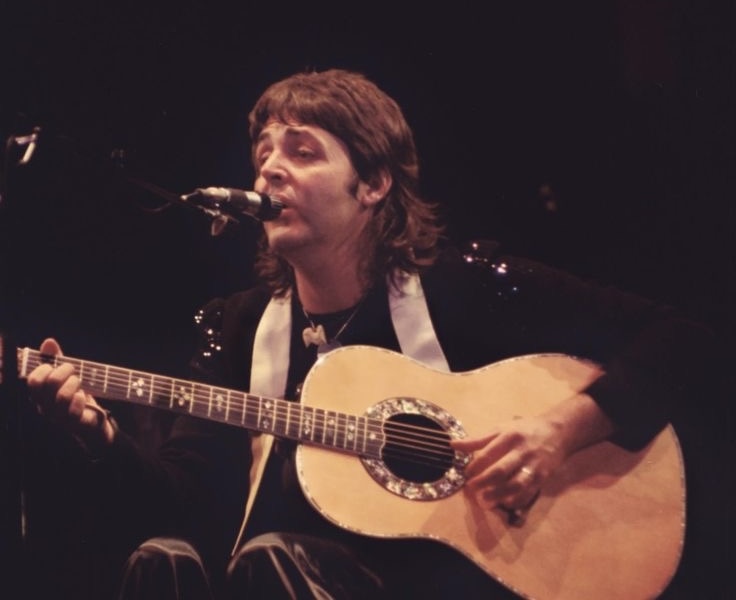
reflections on my favorite artist of all time, a year after seeing him live.
A year ago, almost to the day, I fulfilled one of my biggest wishes: to see Paul McCartney in concert. I was in the middle of finals, it was my last senior semester at university, my thesis was due in a few days, I had around 10 deadlines I had to meet. Yet, I said to myself: “you’re not really about to blow your chance at seeing Paul McCartney live in Paris while this man’s tour has the potential to be his last, now are you?” That’s really all it took for me to buy last minute tickets, grab the Beatles t-shirt I sleep in and rush to the arena.
To say the concert was as close to a religious experience as it can get is an understatement. And while I could write 10 pages alone on what it felt like to be there, I decided to keep that to myself for the moment, and instead, talk about how seeing Paul McCartney live today reveals something people often miss – that behind the Beatles legend lies a restless experimenter and an ordinary, grounded human being whose creativity has never dimmed. This is the central thesis in my case for proclaiming my love to Paul, and I’d like to try and bring you on board with me on this one.
This isn’t going to be an essay on The Beatles. I want to take Paul McCartney as a solo artist and fully lay it out as such, so you understand what qualifies as a “favorite artist of all time” in my book.
seeing Paul McCartney today
There are numerous aspects of his concert that stayed with me (all of it) but a top one of this list has to be his energy. Paul can adapt to anything. It felt like all of his cultivated six-decade musical personalities were on stage at the same time. There was a looseness to him, a warmth that made the whole night feel less like a historic event and more like a gathering he happened to invite the rest of us to. I felt at home. I could scream, cry, and laugh so freely. He completely contaminated me. The man does not stop. I’m talking about an almost three hour concert with NO intermission, just Paul making jokes and interacting with the crowds between songs, no breaks. At one point he even stalled a song intro because someone in the audience was shouting something indecipherable, and instead of brushing it off, he turned it into a bit, riffing in that dry, Liverpudlian way that made the crowd feel like we were all in on an inside joke.
The man on stage seemed remarkably unburdened by the mythology wrapped around his name. He didn’t carry the Beatles on his shoulders; he just played and carried the moment. He looked around at the crowd with a kind of delighted disbelief that he still gets to do this. It was clear that he wasn’t reenacting anything. He wasn’t there to replicate 1964 or 1969 or any other year the world might want to trap him in. The McCartney I saw was a present-tense artist – active, alert, still responding to the room, still finding small ways to make familiar songs feel alive. For a musician who could easily rest on reputation, he behaved instead like someone who hasn’t finished discovering what he can do.
This mirrored the countless interviews I’d watched of him, and affirmed to me that he’s always been like this – that my favorite artist was a pure and honest person. That was the first step in understanding why his art gets to me so easily, no matter how many times I play his songs.
The Ordinary Genius
One of the strangest and most endearing things about Paul is how thoroughly he resists the shape of a “genius” as we tend to imagine one. For someone whose songs are stitched into the emotional vocabulary of multiple generations, he carries himself with a kind of approachable plainness. There’s nothing “tortured” or “precious” about him, terms we often have a lot to say about. He’s just here and he just works.
Based on what I do here and everything I talk about, I’m someone who’s very attached to the act of storytelling, whether it’s coming from me or the people I admire. And Paul is no different. His storytelling between songs capture this better than anything. Instead of capital-H history lessons or grand lyrics, he shares small memories, soft-edged moments, anecdotes. He talks about old friends, narrates recording sessions, early days with his first wife Linda – never delivered with a sense of “you are hearing the gospel according to Paul,” but in the tone of two people chatting around a kitchen table. This simplicity has a way of shrinking the distance between the stage and the crowds, the artist and the listeners, revealing a man who has lived an extraordinary life without seeming extraordinarily consumed by it.
This completely matches the persona he’s maintained for decades: the farmer on a Scottish hillside, the dad who packed his kids’ lunches, the husband who wrote domestic love songs that somehow feel universal. If you take a closer look at it, McCartney’s public image has always been grounded in the everyday, almost defiantly so. And yet the scale of his output – everything ranging from the sheer volume of melodies, ideas, albums, experiments – defies “ordinary” at every turn. How does someone so unpretentious create so tirelessly? How does someone who never cloaks himself in mystique sustain one of the most prolific careers in modern music? The answers lie right there in the questions themselves. In a world that often expects its legends to calcify into icons, McCartney has chosen to stay human. And somehow, that humanity is where the genius lives.
Above all, there is, still, at eighty-plus years old, a genuine childlike enthusiasm in the way he approaches music. He switches instruments the way a kid switches toys, not to show off, but because he can’t help wanting to try everything. His face lights up when a song lands just right. His voice lifts slightly when he introduces one he knows won’t get the biggest cheer. The curiosity is still there – bright, eager, uncomplicated. It’s the curiosity of someone who never put himself on a pedestal in the first place.
And maybe that’s the secret. The big reason why Paul McCartney has kept creating, kept evolving, kept surprising his listeners, is precisely because of this “ordinary” aura. A willingness to remain porous and playful, to stay connected to the simple joys of making sound.
Paul the experimenter
The world tends to see Paul McCartney’s post-Beatles career as some kind of descent from Olympus. I wholeheartedly disagree. In fact, I couldn’t disagree more. Let’s be dramatic about this. The more I listen and discover his solo catalog (as well as the Wings one), the clearer it becomes that Paul didn’t leave a great band – he left the limitations of a great band. And in the decades that followed, he built something even more interesting: a laboratory where curiosity mattered more than legacy.
His home-recorded albums are the clearest evidence of this. McCartney, McCartney II, and McCartney III are acts of creative rebellion, albums that pull the curtain down on the myth of polished perfection. On these records, you hear tape hiss, odd choices, half-finished ideas, the sound of one man alone with a four-track and the freedom to follow any impulse. Where some artists fear the unfinished, Paul seemed drawn to it. He gave himself a kind of permission to be weird, gentle, impulsive.
And long before experimental pop was a genre with its own playlists, McCartney was slipping synthesizers, tape loops, and strange textures into his music. McCartney II has practically become a cult artifact because of this – a record dismissed on release but later hailed as forward-thinking, even prophetic. It’s funny how often his “missteps” age into innovations once the world catches up. Songs like Temporary Secretary or the jittery synth patterns he played around with in the late ’70s feel almost contemporary now, like he accidentally invented pieces of the 21st century.
Even in recent years, that impulse hasn’t dimmed. His collaborations with younger artists – Kanye West, Rihanna, Beck, and so many others – aren’t attempts to stay relevant; they’re proof that he’s always been relevant to anyone curious enough to play. There’s no ego in those partnerships, no sense of “veteran imparting wisdom.” McCartney brings his instincts; the others bring theirs; and the result isn’t nostalgia, but something unabashedly contemporary – echoing my earlier thought on his remarkable ability to adapt.
Take it or leave it, that’s the truth that becomes impossible to ignore once you see him now: Paul McCartney isn’t just preserving a legacy. He’s still building one. The experimenter in him never went away. The tinkerer is still alive, still curious, still reaching for whatever sound might surprise him next. His latest album Egypt Station is proof of that.
a reconsidered legacy
As I’ve seen onstage, his warmth – the casual storytelling, the ease with the crowd – comes from the same unpretentious nature that shaped his family life and his grounded public persona. His stagecraft, though, is the product of decades spent tinkering, inventing, and refusing to stand still creatively. And the way he plays familiar songs with new energy shows that his ongoing creativity isn’t a nod to the past but a commitment to the present. What unfolds onstage is the continuation of a lifetime of curiosity and craft – the three angles of his identity working together in real time.
When you think about it this way, the usual narratives about him – “the melodic Beatle”, “the safe one”, “the traditionalist” – feel increasingly inadequate. They flatten a career that has never stopped expanding. Paul McCartney is someone who is head over heels in love with music. His respect for it, his admiration of it, his passion for it all shine through his work, because that was his whole point from the start. In my opinion, that’s why his longevity isn’t an accident of fame or nostalgia. It’s due to his openness to play, his instinct for experimentation, his discipline as a craftsman, and his refusal to let the mythology around him harden into something static. All ingredients of the magic elixir that allows him to still go on stage and sing at 83 years old (in addition to his daily yoga practice). It is such a beautiful thing to see him as an artist still reaching, still learning, and still making.
One year later – and for many years to come – the memory of that night inhabits me. The setlist, so dear to my heart, and the flawless execution, but above all: the mere presence of Paul McCartney. The chills I got when he asked his musicians to stand down and let the crowd sing Hey Jude. The tears I shed when he sang Now and Then. The pride I felt in knowing so much of his work with the Wings. The way he tried to speak French. The way he treated even decades-old songs as living, breathing creations. It reminded me that genius doesn’t have to be distant or inaccessible; it can be approachable, playful, and human. Just like him.
Seeing him live taught me more about creativity than I ever expected. It’s not about perfection or legacy – it’s about curiosity, openness, and the willingness to keep exploring, no matter how long you’ve been at it. It’s about embracing the joy of the process instead of obsessing over the result. Watching McCartney age gracefully on stage, still experimenting, still engaged, made me reconsider what it means to grow older as an artist – and as a person. And I love him so much for that.
Paul McCartney isn’t just a legend preserved in history. He’s a creator who continues to teach, to delight, and to inspire – and witnessing that in real time was a gift I’ll carry for a lifetime.
here is my playlist dedicated to Paul McCartney for you to start with/enjoy, where you’ll find those gems I’m talking about:

 the back rows
Leave a comment