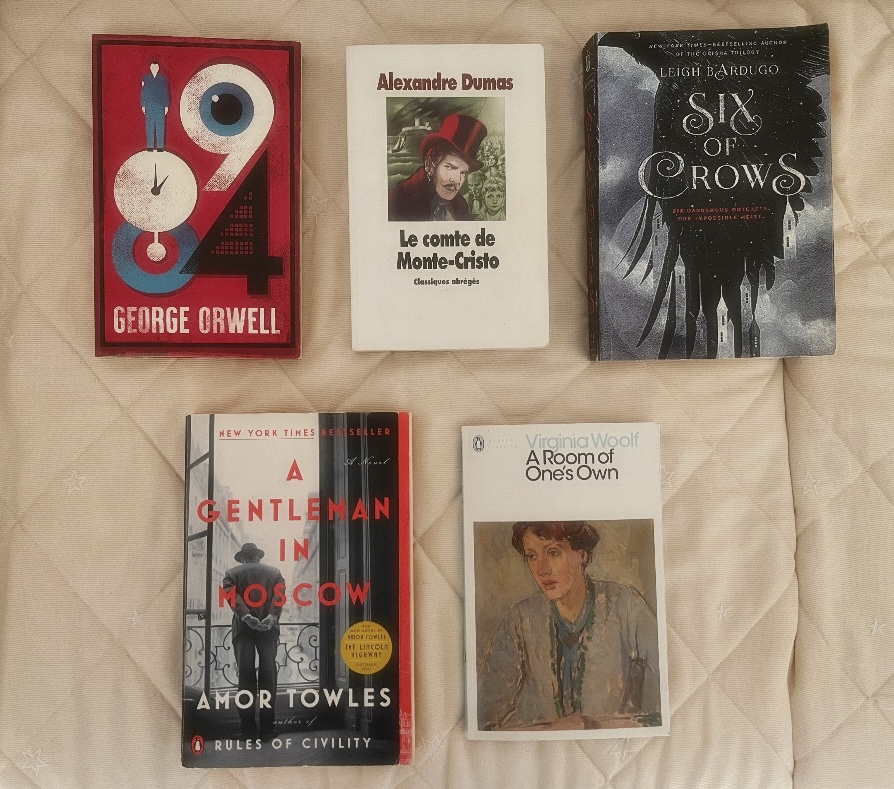
maybe some will speak to you too.
Reading has always been part of my daily routine. While a lot may have changed over the years, this is the one constant. It began when I was a kid, and now, as a slightly bigger kid in her early 20s, I don’t leave the house without a book in my bag, regardless of where I’m going.
Books have been my safety blanket. The quiet architecture of my life – shaping my worldview, sharpening my intuition, and stretching the boundaries of my imagination long before I understood how deeply they were at work. I’ve always been very drawn to the inner lives of characters and writers, the intricate webs of choice and consequence, and the worlds – real or invented – that always reveal something essential about what it means to be human.
Part of what makes my reading journey feel uniquely mine is that it also unfolds across three languages: English, French, and Arabic. Moving between them expands not only the range of stories available to me, but also the textures and rhythms through which I absorb them. As we know, each language opens a different emotional register, and I’m very grateful to have this literary palette that feels so rich, varied, and evidently deeply personal.
Today, the five books I’m listing here aren’t necessarily my “favorite” books (although that might be up for debate), they’re simply the ones that have left the most indelible mark. Some are classic, some are modern favorites. They are the best books I’ve read (so far!), and they’ve accompanied me through turning points in my life, completely challenged assumptions I didn’t know I held, and left me with ideas I continue to revisit years later. And these types of books are very important.
1. 1984 (1949) — George Orwell
This book came to me a few years ago in an interview with Alex Turner – one of my favorite musicians – and my obsession with the Arctic Monkeys’s album Tranquility Base Hotel & Casino. I was completely enamored with this side of science fiction, and I think that no matter which path I was going to choose, I was evidently going to come across the book which we call “the great dystopian novel.” I even remember receiving it by mail and opening it like it was yesterday, as if I knew this was going to be an impactful read.
For the sake of avoiding spoilers or over-hyping the book (and any of them I will be talking about), I’m going to keep it simple: this book terrified me. What struck me most about 1984 is its chilling precision – the way Orwell exposes how language, surveillance, and fear can be weaponized to reshape people from the inside out. Talk about predicting the future! Or at least knowing something we didn’t know. This is THE book that forces you to confront not just political systems, but your own vulnerabilities: how much you want to expose yourself, how easily people can be manipulated, how fragile truth becomes when authority controls the narrative.
Its influence on me has been lasting, and I think anyone who’s read it can tell you the same. It sharpened my sensitivity to how words create a reality, to the quiet erosion of what we deem as freedoms, and to the importance of intellectual independence. Whenever I read or think about power – whether in institutions or interpersonal dynamics – 1984 is the framework that rises to the surface every time. I highly encourage you to read this timeless and mind-blowing book, it won’t ever leave you.
2. Le Comte de Monte-Cristo (1846) — Alexandre Dumas (read in French)
By the time I was 18 years old – which is the time I fully read this book – I had already seen and read so many excerpts of it in school. But I had to experience it from A to Z. This is the book I read that got me out of a reading slump at the very beginning of the COVID lockdown. Normally, its size would have scared me away, but for some reason, it didn’t. I completely immersed myself in that era, and Edmond Dantès was actually my first fictional book crush.
Reading Dumas in French already felt like stepping into the book’s true heartbeat. Other than the fact that the author writes beautifully, the musicality of the language, the dramatic pacing, the intensity of emotion – everything felt heightened and more immediate. No other novel compares to this one’s intrigue and suspense. This is one of the few books that takes its time, yet is never boring. It also takes you to the most satisfying destination for a plot such as this one. Edmond Dantès’s transformation is already something to be in awe of: the journey from innocence to despair, and from despair to a fierce, almost sacred sense of purpose. Simply brilliant.
Le Comte de Monte-Cristo taught me so much about resilience and reinvention. Apart from showing me that justice is not simple, that revenge reshapes the soul, it showed me something bigger – and which at that age, was something I struggled with – that patience, real patience, is a kind of power. Even its scope and moral ambiguity left me with a deep appreciation for long arcs of growth (not an easy task, and altogether quite rare) and I have a feeling it will be the same for anyone who reads it.
3. Six of Crows (2015) — Leigh Bardugo
I count myself fortunate enough to have encountered Six of Crows as my first fantasy book, because it has set the bar very high for me, and has made me appreciate the writing style of fantasy. This book is part of a duology that itself is part of a bigger series of books in the same realm. To make a long story short, I read both books in 2 days, and they are each around 500 pages long. That’s really all you need to know for context.
I have never read such a thought-out book where the world was entirely created by the author herself. I wanted to jump into her mind and figure out how she wrote about a heist in a highly fictionalized manner, where I could picture every single street and building. It is very well done. Besides that, this novel made its mark because it understands brokenness in a way few books do. You get so attached to its characters, who are flawed, traumatized, but clever and deeply human – each carrying shadows that shape their loyalties and betrayals. It’s also a rare case where multi-POV storytelling works so well – where the author taught me how character can drive plot with a breathtaking force.
What I think stuck with me the most here is the atypical concept of a found-family, since it’s not in the traditional way you might think. I felt a part of that family of young characters – who had no one but each other. The novel’s insistence that strength often emerges from wounds and that trust can be both fragile and revolutionary heavily shifted how I think about character-building in fiction, and again, how I interpret resilience in real life.
4. A Gentleman in Moscow (2016) — Amor Towles
As I mentioned, I always have a book on me. One Christmas break a few years ago, I was flying home and of course, had a book to read on the plane. That book was A Gentleman in Moscow. I remember thinking I was going to start it so it would help me relax and maybe fall asleep (not even a miracle can help me achieve that on a plane). Instead, I couldn’t put it down. I rarely say this, but it was the first line that did it for me, which in reality, is the true sign of a great book:
“At half past six on the twenty-first of June 1922, when Count Alexander Ilyich Rostov was escorted through the gates of the Kremlin onto Red Square, it was glorious and cool.”
I can’t emphasize enough how much I like the directness of this sentence, and its last three words, “glorious and cool.” Towles’s novel is a masterclass in grace. My favorite part of the whole thing was that it happens in a singular setting: a hotel. This is one of my most loved techniques in writing – the confinement to a limited place, both in the story AND in the author’s mind. In this book, it turned into a full paradox: a man confined to a single hotel who leads a life more expansive, cultured, and emotionally rich than many who roam freely. The Count’s dignity, humor, and capacity for wonder – even under constraint – was somehow a breath of fresh air, and felt like a quiet manifesto for intentional living.
Out of the many philosophies and lessons in this book – all having gone straight to my brain – some resonate quite frequently. This book taught me to notice beauty in the mundane, to cultivate rituals that anchor me, and to approach limitations not as prisons but as frameworks where meaning can be shaped. It became my own philosophy of living lightly yet deeply – albeit sometimes a little difficult to do.
5. A Room of One’s Own (1929) — Virginia Woolf
I don’t think I could have chosen a better time to start reading Virginia Woolf’s books. This was my most recent prized discovery, and getting into her work in my early 20s is truly one of the best things that could have happened to me. A Room of One’s Own is the first book I ever dared to underline and annotate – a practice which has revealed itself to be extremely therapeutic and personal. I really felt like I was in actual conversation with the author.
This essay struck me as both timeless and urgently contemporary. Her argument – that women need space, both literal and financial, to create freely – felt so unbelievably relatable. A revelation and a challenge all at once that altered my brain chemistry. Woolf writes with clarity, irony, and a fierce, quiet conviction that leaves absolutely no room for complacency. She provokes, she fights, and delights all at the same time. And I think she paved the way for women to do so in that manner like never before.
Aside from this book tapping into the feminist in me, it also influenced how I think about creativity, independence, and the structures that either nourish or stifle a woman’s voice. It made me more protective of my own creative space and more aware of the systemic barriers that still shape who gets to be heard. A must read for EVERYONE, not just women!
“So that when I ask you to earn money and have a room of your own, I am asking you to live in the presence of reality, an invigorating life, it would appear, whether one can impart it or not.”
Honorable mention: The Shadow of the Wind (2001) by Carlos Ruiz Zafón, for which I wrote a full length article you can find here.
What I love most about these five books is not just what they’ve taught me, but how they continue to accompany me. As I grow, they grow with me; as I change, they reveal new facets of themselves I couldn’t have noticed before.
I don’t know which books will define the next chapter of my life, but I know I’ll recognize them when they arrive, in the same way I recognized these: by the way they settle into my thinking, echo in unexpected moments, and remind me that reading is never a passive act. It’s a conversation – where the meaning of a book continuously grows in the space between the page and the reader.

 the back rows
Leave a comment