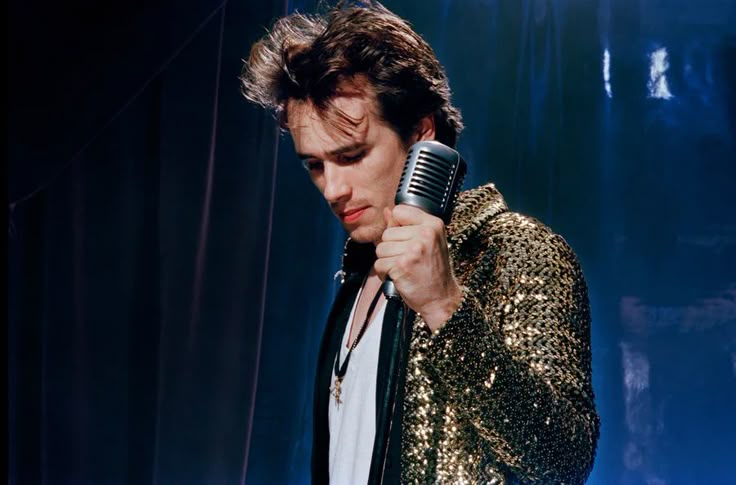
iInside the timeless soul of an album that embodies beauty, pain, and yearning.
It’s difficult to define Jeff Buckley with just a few adjectives, because he was a rather unique soul. What he was essentially was an American singer, songwriter, and guitarist who passed away too early. The son of folk musician Tim Buckley, he carried both the gift and the burden of that inheritance – a voice that could span octaves and emotions with effortless grace, and a restless spirit that never seemed content to stay grounded. But to fully understand him is a task I don’t think even he achieved in his short life.
I first listened to Jeff Buckley about four years ago, when my brother – with whom I share my infinite love of music like with no other – handed me a CD album titled Grace (1994), Buckley’s only completed studio album, and the one that would become his defining work. To tell you the truth, the memory of what I felt when I first heard it is hazy, blurred by the tears that were rolling down my face listening to his lyrics, bathing in the intensity of his melodies, and just feeling inexplicably sad. You’re not just listening to a song on an album; every single one is pulling you into a space where emotion is utterly and completely lived in real time.
In 1994, that kind of unguarded beauty sounded almost foreign. The airwaves were crowded with irony and abrasion – grunge’s grimy catharsis, alt-rock’s detached cool. To appear vulnerable was to risk sentimentality; to reach for transcendence was to risk mockery. And yet here was Jeff Buckley, standing at the edge of the decade’s cynicism, singing with the abandon of someone who didn’t seem to know irony existed.
Grace was, and remains, an act of defiance – a reclamation of vulnerability, beauty, and emotional truth at a time when sincerity felt nearly extinct. It’s an album that treats feelings as something sacred, refusing to apologize for excess or intensity. Simply put, it’s an album I MUST introduce to you.
Track list is as follows:
- Mojo Pin
- Grace
- Last Goodbye
- Lilac Wine
- So Real
- Hallelujah
- Lover, You Should’ve Come Over
- Corpus Christi Carol
- Eternal Life
- Dream Brother
- Forget Her
THE ROMANTIC VISION: BEAUTY AS DEVOTION
To understand Grace is to understand Jeff Buckley as a romantic in the truest artistic sense of the word – someone who believed that emotion was not just a subject for art, but its purest purpose. Through his music, we learn that beauty is an act of faith. To feel deeply is to be alive; to hold nothing back is to reach toward something divine. You can even hear it in his breathing, how he seems to surrender with every breath – to love, to sound, to the moment itself.
This is what we call the Romantic Ideal in motion: beauty pursued at all costs, knowing it may destroy the one who seeks it. In Jeff Buckley’s world, love and pain are inseparable, and he doesn’t hide from this duality. In fact, you can feel it in his performances which seem just at the edge of control, as if he’s forever choosing between restraint and rapture. That tension, the feeling that a song might collapse under the weight of its own feeling, is at the heart of this album.
When I listen to it today, I compliment the music greatly. However, I have come to the striking conclusion that Jeff Buckley’s voice was his most dangerous instrument. I still wonder, in certain parts, how his voice manages to sound so operatic in range, yet intimate in tone. He’s capable of whispering and rising to a fevered cry, sometimes within the same sentence. When you take a look at his influences – Nina Simone, Van Morrison, Led Zeppelin, among others – it makes sense. All of these artists sang as though love itself were a sacred text, and Jeff Buckley was no different in this case.
The title track, “Grace”, is the embodiment of his manifesto. I think heavily of the lyric “Wait in the fire” that he sings repeatedly after the song switches from a delicate start to a storm of sound, with his voice ascending until it almost breaks. It’s a detail such as this one that makes “Grace” rise above a love song, and becomes an invocation. I don’t think he means the fire as punishment, I always took it as the kind of pain that refines rather than destroys, and that you’d need to go through the fire to get to the other side.
The bottom line is: Jeff Buckley treats emotion as something holy. His devotion isn’t to God, or even to a specific lover, but to feeling itself. This is what defines the emotional vocabulary of the album: ecstasy, ache, worship. It’s what makes Grace feel less like a collection of songs and more like a single, uninterrupted prayer.
LOVE & THE ACHE OF LONGING
Make no mistake, these aren’t your typical love songs at all. For Jeff Buckley, love was never about comfort or completion. It was the experience of coming undone, of reaching so far toward another that the self begins to dissolve. We are transitioning from the beauty of wanting to the devastation of never fully arriving.
Buckley’s lyrics make longing a living thing that deep down, we all come to recognize as restless and unattainable. The so-called “lovers” he talks about in his songs are not companions so much as portals – to ecstasy, to oblivion, whatever you want to call it that is something beyond language. Love becomes a mirror for the divine, a means of touching what can’t be held.
He doesn’t just sing about emotion; he embodies it. You can hear it in the crack in his voice when he soars, the raspiness of it when he dials it down. I don’t know if it’s because I’ve gotten so used to his voice, but I can hear motion even in moments of stillness. He transports me to the place he’s at behind the microphone. And when I said his voice was his most powerful instrument, it’s because it acts as a sort of vessel that must be emptied first to be filled. Forgive me for the on-the-nose metaphor here, but by the end of each song, you really feel as though he’s poured every drop of himself into it.
In one of my favorite songs on the album, “Lover, You Should’ve Come Over” – which is perhaps the emotional center of the album – Jeff Buckley transforms heartbreak into something absolutely cosmic. Fans of Grace know the lyric well:
It’s never over / My kingdom for a kiss upon her shoulder
More than that, we know the way it’s delivered. We know how the whole song swells from quiet resignation to an operatic desperation, as though he’s trying to summon the absent lover back into being. That’s the thing too, we don’t know if this is an actual person or if he’s reaching for something farther than that. The woman in question he mourns is less a person than a ghost of grace itself – the idea of love that can never stay. The singer becomes a martyr, forever condemned to the altar of longing.
This might not have resonated with me when I was 19 or 20 years old, but today it does a little more. Every note of this album carries that paradox: that to love completely is to accept its impermanence. Because the longing never truly resolves; it simply deepens, and if you’re okay with that, it will only echo long after the song fades.
what does tragedy sound like in Jeff Buckley’s world?
Now that you have somewhat of an idea of what kind of artist Jeff Buckley was, I think it’s time to talk about the actual sound (as accurately as I can, and it will be a challenge) of the album.
I want to start by saying I’m having trouble believing this was recorded in a studio. Genuinely. The album’s production is so drenched in reverb and air, that it feels like it was recorded in a dream. This might sound ridiculous, but just bear with me for a second and hear my explanation out: it’s the sonic equivalent of memory. Vivid but untouchable, familiar yet fading. (P.S. It will make more sense once you actually listen to the album)
Andy Wallace’s production surrounds Buckley’s voice with space rather than scaffolding, letting it breathe completely. Nothing here is grounded; every note seems to drift upward, suspended in light. Songs feel submerged in feeling, rippling with reflection. Listening to Grace can feel like being underwater, the world above muted and distant, emotion carrying through vibration rather than speech.
Buckley’s guitar work mirrors that fluidity. His playing is rarely assertive or fixed; it flows, bends, and flickers, constantly shifting shape. You can hear it in “Mojo Pin,” where the guitar begins as a lullaby before dissolving into waves of distortion, like emotion overwhelming structure. The melodies move as if obeying a current rather than a beat, highlighting the emotional language of the album.
The dynamics of Grace are crucial to its storytelling. Songs rise slowly, almost tenderly, before erupting into moments of near-violence – not aggression, but the harshness of feeling too much. “Grace”, the title track, is the perfect example: quiet intimacy giving way to a torrent of sound, as if Buckley is testing how much emotion the human voice can hold before it shatters. This push and pull between stillness and explosion, restraint and release, mirrors the cycle of love and loss the album so obsessively explores.
The guitar, bass and harmonies on the last two tracks – “Dream Brother” and “Forget Her” – carry the perfect haunting moments that really stick with you as well. The songs feel both personal and mythic – a message to a friend, a son, or perhaps to himself. As they fade, the album doesn’t resolve; it simply drifts away, like something returning to the water it came from.
All in all, in Grace, tragedy is not a theme – it’s a texture. Every sound, from the trembling vocals to the echoing guitars, carries the awareness that beauty is fleeting. The album doesn’t mourn that fact; it embodies it. The music itself becomes the art of letting go, proof that impermanence can be as breathtaking as perfection.
Grace can be qualified as timeless because it moves, trembles, and aches with the same volatility that defined its maker. Jeff Buckley didn’t treat music as performance, nor was he chasing perfection, he made it into a place where beauty and pain could coexist without explanation. To make something eternal, you have to let it die. And in Grace, he does – over and over again, in every note that swells and dissolves, in every silence that follows a cry. The album endures not because it resists mortality, but because it embraces it, turning loss itself into song. In the world of art and its ability to tap into our deepest emotions, it is an album I strongly recommend to anyone.
The tragedy of Grace isn’t that Buckley died young (although for me, it is); it’s that he lived and sang as though every moment might be his last. That urgency, that surrender, is what keeps the album burning decades later. It remains a testament to the ultimate Romantic belief that feeling – in all its chaos and radiance – is the closest we come to truth.

 the back rows
Leave a comment