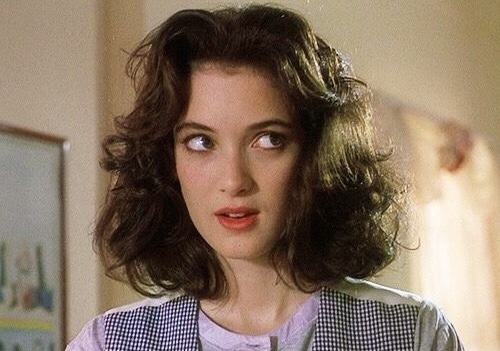
a love letter to the outsider, the rebel, and the intelligent “cool girl” I looked up to.
Cinema was always a big part of my life. Films, TV shows, music videos… The idea that you could create lives, aesthetics, entire worlds on a screen was so magical to me. It still is, albeit a bit diminished from the evident act of growing up, but nothing compares to the feeling of it being just me and that world on my screen–that sometimes felt like it could step out of that–in my dimly-lit room with the rain hurling itself against my window.
And of all the magic cinema provided–the stories, the characters, the emotions–I always longed to see my own reflection, or a somewhat close encounter to it. Something that told me I also existed outside of my own little realm, something that made me relatable, something that turned my own little inner world into a character.
When I was 17 years old, I found that something–or rather, that someone– and her name is Winona Ryder.
The first time I saw Winona on my screen was in Stranger Things, her most recent work. I already loved her, and would not stop reading about her. This, of course, sent me to hunt down everything she was in–Heathers, Edward Scissorhands, The Age of Innocence, Girl, Interrupted, Dracula… And in doing so, I noticed that she was unlike any other actresses everyone else was talking about. She seemed to exist in her own frequency. She was beautiful, but not in the way we were told to admire beauty. Her face carried thought, hesitation, rebellion. You could see the flicker of doubt behind her eyes — a kind of vulnerability that didn’t ask to be fixed. In all of these films, she felt like a different version of the same language: the constant reminder that thinking too much, feeling too much, wasn’t a flaw. It was a kind of art.
Back then, I didn’t realize I was studying an archetype – one that would come to define not just her career, but an entire cultural idea of girlhood. All I knew was that she made me feel less alone. That her world — full of misfits, ghosts, and darkly funny pain — felt truer than anything glossy or perfect ever could. Today, it makes more sense.
“Welcome to the world of the emotionally mature. It’s a nice place to visit.” – Winona Ryder as Lelaina Pierce in Reality Bites
defining the archetype – who is the “Winona Girl”?
More than just a character type – the “Winona Girl” is a mood, an energy, a quiet resistance. She’s the haunted girl, if you will: sensitive, self-aware, slightly out of step with the world but never entirely outside of it. She’s not “being weird” for attention; she’s simply existing in her own orbit, often misunderstood because she refuses to translate herself into something more digestible.
Winona’s characters have always lived inside contradictions. She’s fragile yet defiant, sad yet electric, the kind of presence that makes melancholy look like movement. Notice that when she speaks, you get the sense she’s thinking about three things at once – the truth, the pain beneath it, and the absurdity of having to explain it. What I like most about her is that there’s no artifice in her performances; they have the kind of honesty that can’t be faked.
You’ve probably seen all of the characters but didn’t particularly think about it twice. Yet you can trace the archetype through her filmography like a constellation. Lydia Deetz from Beetlejuice, the original misunderstood goth girl, turning her alienation into armor. Veronica Sawyer in Heathers, too smart for the cruelty around her, dissecting it with both disgust and fascination. Kim Boggs in Edward Scissorhands, learning to love what others fear. Suzanna Kaysen in Girl, Interrupted, punished for feeling too much, for refusing to tidy her emotions into something polite. And decades later, Joyce Byers in Stranger Things – the grown-up haunted girl, still fragile but no longer breakable, surviving by the sheer force of her belief.
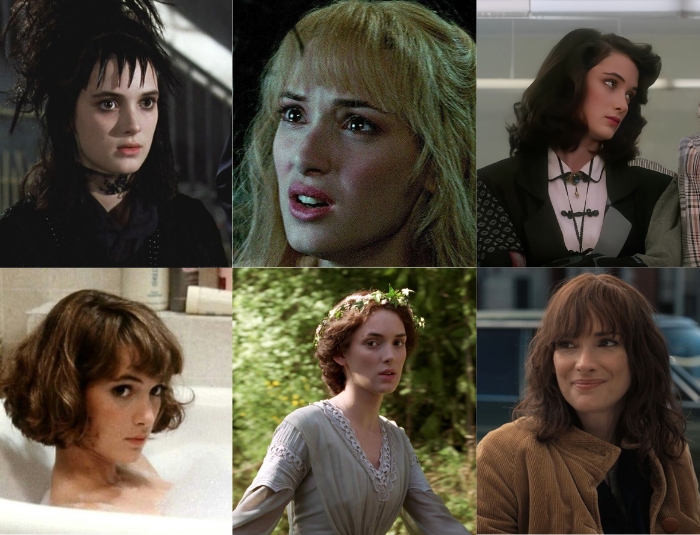
What binds these characters isn’t style–though the dark-colored clothes and deep gazes became shorthand for it– it’s the emotional intelligence that comes from watching everything too closely. The sensitivity that can’t be disguised. The quiet rage of being told you’re too much and not enough at the same time.
You might be familiar with the internet’s new way of naming the “Winona Girl”: “the weird girl aesthetic,” “the dark feminine,” “the misunderstood cool girl.” But I don’t believe Winona was ever an aesthetic. She was and still is an emotion. Long before Tumblr mood boards and TikTok edits, she embodied the beauty of being unfiltered, of refusing to sand down the edges that make you real. She didn’t even want to be understood by everyone. She only needed to be seen by the right few — the ones who knew that being haunted by something doesn’t mean broken. It means human.
“When you finally accept that it’s OK not to have answers and it’s OK not to be perfect, you realize that feeling confused is a normal part of what it is to be a human being.” – Winona Ryder in an interview on her film Autumn in New York
More Than Just a Phase
Loving Winona Ryder was never about celebrity or grand admiration for me, it was recognition. There was something in the way she moved through the world, both hesitant and fearless, that mirrored how I felt moving through adolescence. I was a very shy person, but with a million ideas fighting inside. Quiet but somehow still full of noise. Watching her on screen felt like finding someone who understood the strange mathematics of being too sensitive in a world that rewards indifference.
She made vulnerability look like strength. There was power in her softness – not the performative kind, but the real, trembling kind that comes from feeling everything and surviving it anyway. While most movie heroines seemed certain of themselves, Winona’s characters carried uncertainty like a secret language. They looked like girls who stayed up too late thinking about the end of the world, who loved too hard, who wanted to disappear and be seen at the same time. I understood that kind of wanting, and a big part of me still does today. I recognize that adolescent feeling I carry with me in my early twenties and I have a soft spot for it still being with me.
I remember wanting to be exactly like her and her characters. The ages of 17-19 were filled with her face. She was my inspiration for so many haircuts and grunge makeup looks where I proudly embraced my eyebags. I’d sit in front of Stranger Things and recite her dialogue with her. I had a journal I kept where I wrote in the same angry, spontaneous style as she does in Heathers. I kept telling everyone I knew that she was supposed to play Michael Corleone’s daughter in The Godfather and citing the many reasons why she would have done an amazing job. One halloween, it took me three hours to perfect my costume of Veronica Sawyer from Heathers in the final scene where she’s all bloody and crazy.
It was more than just looking like her. It was a way to step into an identity that felt closer to who I actually was. Winona made it okay to be intense, to be observant, to be the girl who didn’t float passively through social life. Through her, I learned that being misunderstood didn’t mean being unworthy – it just meant you saw the world differently, and that it was totally and completely okay. She represented a kind of girlhood that wasn’t built for approval. She made space for the interior life – the quiet, restless, intellectual ache that didn’t have a name yet. She showed that it was possible to live inside your contradictions and still be whole.
To make this even better, and in a way that completed that full circle of my teenage years into my early adulthood, I discovered a few years ago that she is a huge cinephile and music lover, with excellent taste in both might I add! So, more than her characters, which she carried with her in a similar but calmer way, I saw that she and I would have a lot to talk about. It also showed how much respect and love she has for art, and the passion with which she talks about it. To me, she is and always will be an absolute delight to listen to.
“I’m very attached to movie theaters and I love going to them. Nothing will ever replace that. It’s very romantic and beautiful. I used to want to live inside of one, with a bathtub, a bike and a bed, and just watch movies.” – Winona Ryder in an interview with Collider
the Winona Ryder archetype endures
The Winona Archetype didn’t disappear in the 90s–it evolved. You can see traces of her in nearly every character who dares to be both self-aware and strange. Wednesday Addams in her latest Netflix revival carries Lydia Deetz’s DNA – the same dark humor, the same elegant alienation. Daria Morgendorffer’s deadpan intellect, Juno MacGuff’s too-smart-for-her-own-good wit, Rue Bennett’s fragile honesty, even Lydia Tár’s unraveling – all feel like distant relatives of the emotional honesty Winona brought to the screen long before it was cool to be complicated.
Her influence endures because she never tried to manufacture coolness; she simply refused to apologize for her awkwardness. In an era obsessed with irony, Winona was sincere. While others built personas, she seemed to shed them – her power was in her transparency, the way she made interior life visible. She didn’t flirt with darkness for aesthetic effect; she lived in it, examined it, and somehow made it beautiful.
That’s why her second act feels so fitting. Joyce Byers in Stranger Things isn’t a departure from her early roles – she’s the grown-up haunted girl, still vibrating with that same nervous energy, still too feeling, too protective, too much. But now that intensity is survival, of course, with a slightly different kind of charisma that makes Joyce a fan, and mine’s, favorite. Joyce’s character and the way Winona plays her shows that emotional realism – the raw, trembling kind – never goes out of style.
And maybe that’s why, in the spirit of this piece coming out around Halloween, her presence feels especially magnetic. People call her the “Queen of Halloween,” but it’s not because she plays monsters. It’s because she embodies what Halloween really means: transformation, mystery, the courage to inhabit the parts of yourself that scare others. While the world puts on masks for one night a year, Winona has spent her entire career taking them off.
In her, we recognize that darkness isn’t something to escape – it’s something to understand. Therefore, the “Winona girl” doesn’t hide from the strange, the sad, or the uncertain; she makes a home there. And in doing so, she’s given generations of us permission to do the same.
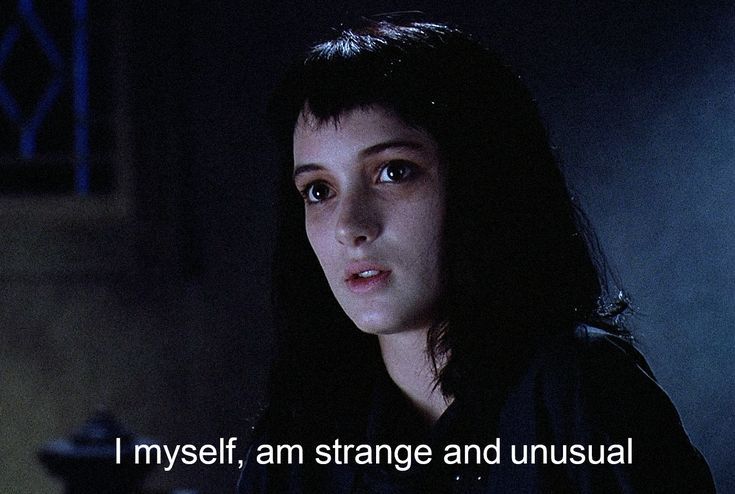
Growing up didn’t erase the part of me that loved Winona Ryder. It just made me understand her and learn from her more. The girl I once idolized – the one who hid behind black clothes and restless thoughts – didn’t vanish with time; she softened, evolved. She learned that sensitivity isn’t something to outgrow, but something to refine. That girl becomes the woman who listens deeply, who feels everything and still keeps going.
Every generation needs someone to remind them that honesty can be cool, that weirdness can be luminous, that sincerity is a kind of rebellion. For me, it will always be Winona Ryder, even if she’s not directly from my generation. The “Winona girl” will live on – in the quiet artists, the thoughtful misfits, the people who walk through the world with open eyes and open nerves.
It’s funny that I’m writing this and thinking of my favorite line of hers in Reality Bites when she says: “I was really going to be something by the age of 23,” to which her co-star Ethan Hawke’s character responds: “Honey, the only thing you have to be by the age of 23 is yourself.”
I am 23 today, and I have absolutely no idea what I thought I’d be now at the age of 17. Really, I couldn’t even tell you. I just know today that the goal was never to become something extraordinary, but to become someone honest and real, the biggest Winona lesson of all.

 the back rows
Leave a comment