written by Tayma Saliba
Act I — The Dome
The city lay beneath a glass dome so vast it felt as if the sky had been bottled. Its curve swallowed everything in soft, diffused light, a pale luminescence that made no distinction between morning and dusk. Every surface seemed to breathe — reflections rippling across wet streets, glass panels shifting imperceptibly, as though the entire city were exhaling. So fragile. One wrong step, and it might shatter, spilling its light and air into the void beyond.
We walked through it — a small cluster of figures moving together, our steps scattered in rhythm, voices threading softly through the hush. I don’t remember how we arrived there, only that we were already walking, the air damp and humming faintly, the sound of our shoes carrying farther than it should have. Our reflections stretched thin across the puddles, trembling as though unsure whether to exist.
Dad was the one who insisted we see a play. He said it was the kind you never forgot — “a real experience,” he called it — showing in what he claimed was the last working theater in the city. My father didn’t like plays; I’d never once heard him mention a play. I cannot remember the name of the one he was taking us to see.
No one questioned him, though. In that place, it felt easier to go along with things. The streets folded in on themselves, long corridors of glass and stone that seemed to rearrange when you weren’t looking. The light hung heavy, bluish and dim, casting thin halos around every moving shape.
We reached the ticket booth — a small structure tucked against the edge of a narrow street, so still it looked more like a display than a place that served people. The man behind the counter had skin pale enough to reflect the glow from the neon panels above, his eyes flicking up only briefly as he slid a neat row of tickets across the metal ledge.
So far, he was the only other person we’d encountered. His expression was composed, but something in it faltered when Dad thanked him — a split-second hesitation, as though the word had caught him off guard.
Dad asked for directions, and the man’s lips moved, muttering instructions that seemed almost… rehearsed.
“It’s the little building with the green façade,” he said, his tone flat. “You can’t miss it.”
I noticed how his eyes darted to the corner of the booth, how his fingers trembled slightly before retreating beneath the counter.
As we walked away, I couldn’t shake the feeling that there was something off – a flicker in his eyes, a hesitation in his smile – like he was giving directions he hadn’t even fully believed himself. I turned back once. He was still watching us, his face half-lit, half-swallowed by shadow. And just before I looked away, I thought I saw his reflection in the glass wall behind him move a fraction of a second later than his body did.
The streets narrowed as we went on. The buildings grew lower, older, their walls streaked with something like soot or dust that shimmered faintly under the dome’s light. No wind. No sound. Only the faint hum that seemed to follow us — a mechanical breath beneath the ground.
We passed through an alley where the walls curved inward, glass meeting glass in a perfect arch. Our footsteps echoed back at us, slightly delayed, as though something were following from just a few steps behind.
When the green façade finally came into view, I felt a flicker of relief — something tangible, a destination. But as we drew closer, that feeling soured.
The theater was in ruins. Green paint flaked like wind-scattered leaves, door chained, windows fractured into jagged lines. I could see them, barely: the seats ripped, mottled with age. The only sound we heard then was a low hum that rose from the floorboards. The sign above the entrance had long since lost its lettering.
No one spoke at first. There was something in the air, dense and still, like the residue of sound that refused to fade. Dad stepped forward, muttering, checking the address, peering through the gaps in the boards as if an explanation might be waiting inside.
Panic began to ripple through the group — confusion first, then irritation, then something like fear. Why would that man sell us tickets if the theater was out of service?
We retraced our steps, our reflections moving beside us like silent twins.
The booth looked the same when we returned — same flickering light, same cold stillness — but the man seemed startled to see us. His eyes darted nervously toward the street behind us, as though he’d forgotten there was anything beyond his small window.
Dad leaned toward the counter, voice tight, asking for an explanation, as the rest of us waited not too far.
The man simply said he’s sorry, that he wasn’t informed of the state of the theater. Something about the way he said it — flat, rehearsed, like he was reciting a line from a script that no longer fit — made him sound like a robot.
No one noticed, but the sound beneath the city grew louder then. A faint vibration through the soles of our shoes, as if the dome itself had sighed.
Act II — The Rain
I looked around, searching the others for reaction, and for the first time, I realized I haven’t the slightest idea who they are, and why they’re with me here. Their faces seemed wrong — blurred by the reflection of light against the dome, as if a faint film of glass stood between us.
It wasn’t that I couldn’t see them; it was that I couldn’t fix them. Their features shifted whenever I tried to focus — outlines bending, eyes glinting one second and gone the next, like faces in a crowd you think you recognize until you don’t. Only my father’s voice anchored me, sharp and familiar, echoing faintly against the slick walls.
He was still arguing with the man in the booth, words overlapping in that same rhythm the city seemed to breathe in. Then, somewhere between their voices, the rain began.
At first, it was only a mist, thin and almost weightless, descending from nowhere. I tilted my head back instinctively. There was no cloud above us, only the curve of the dome — clear, unbroken, holding the world inside like a drop of glass. Yet the rain kept falling, silver threads glinting as they drifted down. I seemed to be the only one wondering how it could possibly be raining inside a glass dome.
I could feel it before I could hear it, soft at first, then heavier, turning the ground into a rippling skin of reflections. I looked at the others — the indistinct figures shifting around me, moving in confusion.
No one had an umbrella.
Except him.
He was standing a few steps away, slightly apart from the rest. I don’t know where he came from — whether he’d been with us the whole time or had just stepped out from one of the reflections, and I couldn’t put my finger on how— but I knew him. Not by name, not by memory, but by recognition that lived somewhere else. His face was clear where all others blurred, steady and impassive beneath the pale light. It was as though the city, in all its distortion, had chosen to leave him untouched. The only one whose features I could hold onto. The only one I wasn’t afraid to approach.
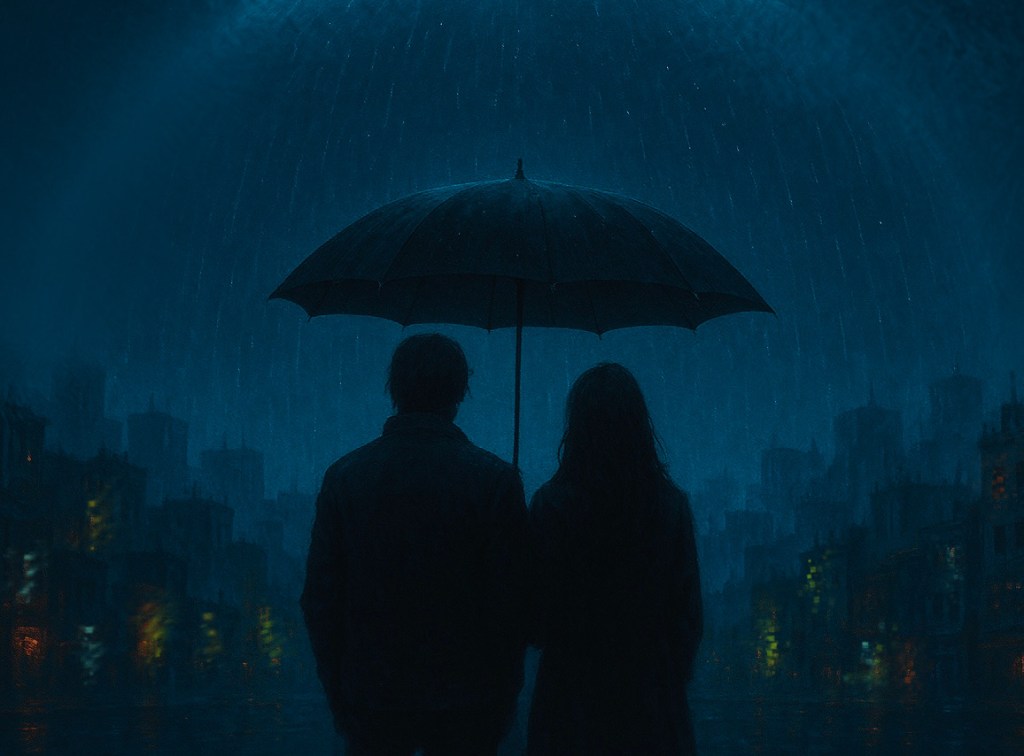
He opened the umbrella, slow and deliberate, the sound of the fabric unfolding impossibly loud in the rain. The circle of dry that formed around him glowed faintly in the dome’s light, as if it were more than just an absence of water — as if the air itself shifted there.
Everyone rushed toward him, voices rising, but there was only space enough for two. The others pressed close, their outlines shimmering like static through the rain, and I could feel the panic in the air — that animal pulse of wanting to stay dry, to stay safe. I don’t remember deciding to move, but somehow, I was already there, stepping into the circle with him.
The air inside felt different. Still. The sound of the rain dimmed, the rest of the world slightly out of sync, as though it had slowed to another rhythm.
Outside, the figures were still moving, still arguing, still trying to find space — but with each heartbeat, their edges blurred further. I blinked once, and one of them was gone. Another blink — a shoulder vanished. A sleeve. The sound of my father’s voice, calling out to the man in the booth, thinning until it was no more than an echo disappearing into the silver haze. But there was no fog. One by one, they were gone.
I turned to him.
“They’re— they’re disappearing,” I whispered. “Look.”
His eyes followed mine. For a long second, he said nothing, only scanning the emptying street, the puddles trembling under the rain. I could see the realization settle in his eyes. The puddles that had mirrored so many shapes now showed only two.
“I see it,” he said quietly. His voice wasn’t afraid. Just… aware.
For a moment, neither of us spoke. The sound of rain filled the space between us. We looked at each other, trying to telepathically figure out where they went, why we’re still here, when I look up and it dawns on me.
The umbrella.
The only difference between us and them was the thin shield of dry air above our heads. The line between wet and dry, existence and absence. Whatever this rain was, it wasn’t rain at all.
Act III – The Umbrella
We started walking without really deciding to. The city stretched before us in long, silent corridors of artificial light, every surface glistening, the air carrying the faint metallic tang of rain on glass. The dome above shimmered faintly, as though the rain striking it from inside had turned into starlight.
There really was no one left now. The streets we’d crossed not long ago were emptier still — puddles reflecting signs that still blinked in meaningless rhythm, storefronts warped by the water gathering at their feet. A bicycle leaned against a lamppost, its light still on, as if someone had only just parked it there.
I remember thinking we should be terrified. That any second, the calm would split open, and something would happen. But it didn’t. We just kept walking, our reflections moving with us — two figures beneath one umbrella, framed by a world that had stopped breathing.
The rain pressed against the edge of our small shelter, its sound constant, like static. Inside that narrow circle, the air was warm, close. I could hear him breathing beside me — steady, quiet — and for a moment, I felt as if the city was moving to that rhythm instead of its own.
We hadn’t talked much, but it didn’t matter. Words felt like they didn’t belong here — they belonged to the other world, the one that had disappeared with the rain. Here, silence had its own kind of language. A breath. A glance. The small, deliberate movement of staying close. He held the umbrella steady above us, the faint sound of raindrops gathering and sliding down the edges. Every now and then, he’d glance back — not to check, but to make sure I was still there. There was something protective in the way he did it. Not overt, not rehearsed — just quiet, natural. I found myself watching the way the light caught the curve of his shoulder, the rhythm of his steps, how he didn’t seem to waver even as the city warped around us. The air under the umbrella was warmer, almost separate from the rest of the world. Sometimes our arms brushed as we walked, and in those moments, the silence didn’t feel heavy anymore. It felt like the kind that holds things together, filled only by the quiet presence of another human being.
We turned down a narrow street that curved toward the edge of the dome. The glass wall rose before us like the inside of an ocean, glinting faintly blue. Beyond it, darkness stretched in every direction. The only visible thing was the faint shimmer of stars, scattered so densely they looked like dust caught in light. There were too many of them, far too many, though maybe it was only that the world had never let us see them this close before. I’d never seen stars from the heart of a deserted city before, with no streetlight or noise to soften their reach, so I wouldn’t know.
But when I looked closer, having to squint, I thought I saw the faint outlines of other buildings beyond the glass — towers, rooftops, narrow balconies — their shapes softened by the dark. For a fleeting moment, something in their arrangement felt familiar. A corner I’d passed before. A skyline I almost recognized. My hometown, maybe. Or some version of it. But the longer I stared, the more the details seemed to slide away, dissolving into shadow until there was nothing left but reflection.
He tilted his head toward it, and I followed his gaze. The stars looked too close, almost pressed against the glass, like they were watching us.
“Do you think,” I said quietly, “that it’s really night out there?”
He didn’t answer at first. The reflection of the stars flickered across his face, softening his expression, and when he finally spoke, it was almost to himself.
“I don’t think we’re anywhere at all.”
Something about the way he said it — calm, certain — settled inside me. There was no sadness in it, no fear, just an understanding.
We kept moving, slow and unhurried, staying under the umbrella. We didn’t even think of closing it. The idea never came — like our bodies already knew it wasn’t safe. Still, it didn’t feel like restraint. It felt natural, necessary.
A light gleamed somewhere ahead, a sign still buzzing above a shuttered café. The windows were fogged, and through them I could see shapes of chairs and cups, untouched. He shifted the umbrella to his other hand, arm brushing against mine, a quiet exchange of warmth in the chill.
“My arm’s getting tired,” he said softly, almost with a smile.
“I know,” I said. “But we can’t close it. I don’t… We don’t know where we’ll go.”
He nodded, and that was enough. I didn’t need to explain further. The city seemed to agree — the sound of rain softening, the lights dimming to a low hum.
We stopped walking after a while. There was nowhere to go, really. The air felt thinner near the edge of the dome, and the stars seemed brighter here — too bright, too many. The silence between us stretched but didn’t feel empty. He placed a hand around my shoulders, a quiet, instinctive gesture, and for the first time since the rain began, I let myself exhale.
I think I expected the world to flicker out then, for the dome to shatter or the rain to stop. But it didn’t. It just stayed — this strange balance of stillness and motion, of being inside something that could collapse at any second but didn’t.
He turned toward me, and before I could ask what he was thinking, he leaned in slightly and kissed my forehead.
It wasn’t a grand or comforting gesture — just simple, human. The kind of gesture that said are you still here? Even if we don’t know where “here” is anymore.
For a moment, I thought the light shifted — the stars pulsing, the reflection of our umbrella glimmering on the glass. I looked at him and blinked once.
One blink for yes – I’m here.

 the back rows
Leave a comment