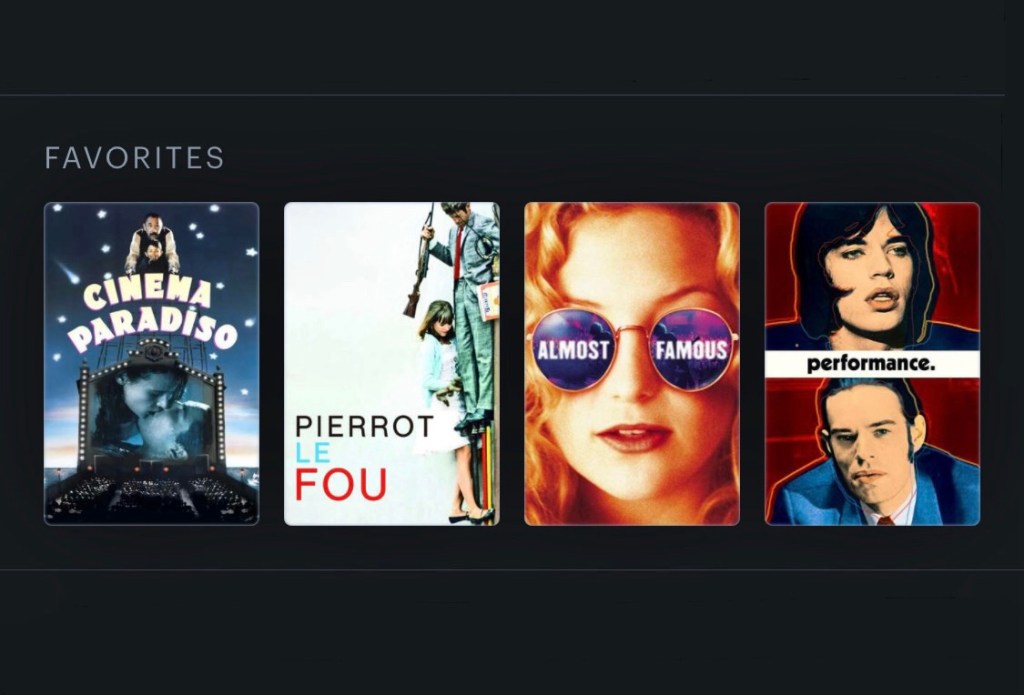
why these films earned their spot in my top four on Letterboxd.
Letterboxd is a social platform that I really enjoy using. And no, before you think it, it’s not just for “pretentious film students who want to show the pretentious films they watch.” Even if that’s the case, so be it! Good for them. But anyone can be on there.
Letterboxd is a place where people essentially log what they watch, write reviews, and share their cinematic tastes with others. One of its most recognizable features is the Four Favorites section that pops up when you open someone’s profile, where said person highlights the films that basically mean the most to them. It’s really interesting, because it can say a lot more about someone’s relationship with cinema than a long list ever could. Of course, they don’t necessarily represent a complete picture of one’s viewing habits, but they act as a kind of snapshot for that. I sometimes don’t realize how true that is until I look at my own lineup, and then it’s just staring at me right in the face.
With that in mind, here are the four films that currently hold a place in my Letterboxd favorites—and the reasons behind each choice.
Cinema Paradiso (1988)
Directed by Giuseppe Tornatore, this Italian film tells the story of a young boy’s friendship with a local cinema projectionist and his lifelong love of movies.
My parents were the ones who introduced me to this film. It was in the middle of winter back in 2020, when Covid hit and much of our time was spent watching all sorts of movies. It was also the start of my passion for cinema, and since the film literally captures the magic of cinema itself, my parents deemed it an essential watch. They were absolutely right.
The way the film shapes memory, friendship, and identity is so pure and emotional. Looking back at it now, it’s so timeless because of its exploration of growing up and chasing dreams. What made me love it was its innocence and simplicity; Cinema Paradiso is a great example of certain hallmarks of Italian cinema, particularly from the post-war and modern periods. The nostalgic, humanistic storytelling; the influence of neorealism in portraying everyday life; the celebration of community and the magic of art (cinema in this case), and I will never forget how this was my introduction to Ennio Morricone’s music, who has become my favorite composer.
I think the main reason this film is up there is because I will always be that kid in the movie who still finds magic in seeing a film and observing/talking to others about it. And when I get older, and possibly forget that, I’d like this film to be my reminder. I like to think there’s always one film that propels you in the world of cinema more than others, and this was that for me.
Pierrot Le Fou (1965)
One of my favorite directors Jean-Luc Godard’s best films, Pierrot Le Fou is a chaotic tale about a man who abandons his conventional life and runs off with a woman in 1960s France, spiraling though a series of adventures and reflections on love and society.
I watched this film when I was in Paris a few years ago on a trip. It was right after the world started opening up again after the pandemic, I was a little older and had completely immersed myself in cultivating culture at home. So, no wonder I went to Paris with the idea to visit everything I could visit that had to do with my new obsessions.
It’s no denying that Jean-Luc Godard was a master of the French New Wave, the era of cinema defining that period of time between the sixties and seventies, and later inspiring many films from around the world. I didn’t hesitate to include this film in my top four because I was immediately taken in with its bold visual style and playful narrative structure that made it feel so experimental. The plot itself is not so dense. In fact, some might argue that nothing really happens. The beauty of it lies in the challenge of traditional storytelling. It’s not easy, but this film succeeded at it. For it to be as much about the cinematic style and freedom as it is about the characters, Godard blends romance, crime, and a ton of social commentary—my personal favorite part. I love the way he critiques consumerism, bourgeois values, and conventional life, mirroring the cultural upheaval and questioning of authority that defined the era, a politically charged aspect that can still be seen today.
My favorites scenes from that film are when the characters break the fourth wall, i.e. stare right at the camera and talking to the audience in a way. When Godard did that in this film, the words took on a heavier meaning, as if he was speaking to me directly, and in this case, I really appreciated how invasive it was. It felt like a warning, and I took it.
Almost Famous (2000)
If you asked me about my dream life, this would be it: a semi-autobiographical coming-of-age story about a teenage music journalist touring with a rock band in the 1970s. In other words, the plot of Almost Famous, directed by Cameron Crowe.
The BEST part about this, is that this summary doesn’t even BEGIN to do justice to what this film is really about. Aside from its perfect soundtrack (that I won’t get into here because it will never end), it’s such a heartfelt exploration of youth, fandom, and the thrill of discovering you own voice—even if it doesn’t have to do with music.
My brother and I share the biggest love for music, and he was the one to advise me to watch this movie. I can picture myself very well on my tiny couch in my mezzanine at home in the middle of a cold January night, pressing play on this and feeling every single fiber of passion I have for music for the next two hours. The film doesn’t try to be this big thing either, it’s literally just about a group of people—some musicians, some not—and their relationship with music, with as many talented and charismatic actors as you can imagine (Kate Hudson and Billy Crudup, I’m looking at you), blending humor, emotion, and nostalgia in a way that resonates with anyone who’s ever been passionate about art.
This one felt like a hug. An embrace for the spirit of 1970s rock culture, the eternal concept of the coming-of-age relatable storytelling, personal experience, the deeply human sensation of belonging, and the source of one of my favorites quotes:
“I always tell the girls, never take it seriously. If you never take it seriously, you never get hurt. If you never get hurt, you always have fun; and if you ever get lonely, just go to the record store and visit your friends” – Penny Lane in Almost Famous
Performance (1970)
A surreal, gritty crime drama about a gangster hiding out in a rock star’s home in London, this film directed by Donald Cammell and Nicolas Roeg is nothing like it seems.
There’s got to be at least one surprise on my list. A film that while watching, I never thought would be considered for my top favorites. And Performance is that film.
The story of why this film is my top four is one that I’ve repeated so many times to my friends and family, not only in defense of it, but because the way it happened took me by surprise. I was taking a class on Film and Music two years ago, and our professor showed us this film when the topic of our class was late-1960s and early 1970s British music in cinema, so on the music part, we were already covered. No problems there whatsoever. Now, without spoiling the plot of the movie, I can only tell you that it entirely blends identity, violence and music, in this portrayal of alter egos between Mick Jagger (yes, you’re reading this correctly) and James Fox’s characters. And I could not be more uncomfortable while watching it. A duality here: I couldn’t keep my eyes off the screen either.
I walked out of that class wanting to forget what I just watched. Yet, I couldn’t. I found myself doing research on the film, listening to the soundtrack, re-reading the material we had to read for that class, talking about it endlessly to the people around me… And when it came to rating it on Letterboxd: a five star. The film completely provoked me. Its take on identity with elements of psychological intensity scared me yet stayed with me. Mick Jagger also gave a mesmerizing performance as the boundaries between narrative and character are completely pushed (with a music video that is one of the coolest I’ve seen). It is a perfect blend of crime and counterculture, and one of the most daring, avant-garde work of its era. I sort of felt forced, through no control of my own, to include it in the list of the films that marked me most.
These four films don’t cover every corner of my taste, but together they form a snapshot of what I personally highly value in cinema: memory, rebellion, passion, and experimentation. They also are subject to change—although they’ve been up there for a while—since there is so much more to see! I also love how most of them were introduced to me by someone else, which is something really nice about cinema—just the sharing of it. And that’s part of the fun of Letterboxd’s “Four Favorites”: it’s always in flux, a conversation starter as much as a statement.

 the back rows
Leave a comment