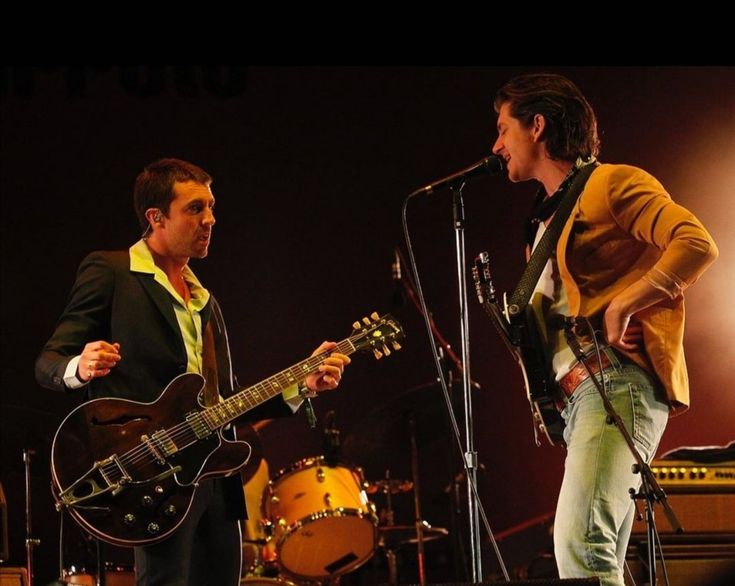
how Alex Turner and Miles Kane turned excess and surrealism into one of the 2010s’ most audacious cult albums.
It’s funny how the culture of gatekeeping got to me without me ever realizing it. I know this because the band I’m writing to you about today was something I always considered my most prized discovery in music, and I only really ever talked about it to a select number of people. But after 5 years of constant listening, binging every available concert on YouTube and watching countless amounts of interviews with The Last Shadow Puppets, it’s time for me to share.
The Last Shadow Puppets have been making music since 2008, and have since only produced 2 albums. While both beautiful in their own way, the 8 year gap between them is heavily felt when compared. When the band returned on April 1st 2016 with their long-awaited second album, Everything You’ve Come to Expect, it instantly stood apart as one of the most daring releases in modern rock. We’re talking about a decade where indie music often leaned toward stripped-down minimalism and electronic polish, and Alex Turner, Miles Kane and producer James Ford did the complete opposite: they doubled down on lavish orchestration, baroque-pop excess (a fusion genre that combines rock music with particular elements of classical music), and a distinctly cinematic atmosphere that seemed like it was taken straight out of a noir film soundtrack.
Since their debut, The Age of the Understatement, Alex Turner (Arctic Monkeys frontman) and Miles Kane had obsessions with 1960s drama, using string instruments to build momentum, and theatrical storytelling—all of which stood apart from Turner’s work with Arctic Monkeys and Kane’s solo career respectively, and is a big part of my own obsession with them exploring those different elements when they were together. As mentioned before, their sound can somewhat be recognized in the second album, yet at the same time seems like they went in a different direction that wasn’t “safe” or “conventional” in a sense. As critics describe it, it was “a record dripping with surreal imagery, playful decadence, and unapologetic flair.”
Everything You’ve Come to Expect’s track list is as follows:
1- Aviation
2- Miracle Aligner
3- Dracula Teeth
4- Everything You’ve Come to Expect
5- The Element of Surprise
6- Bad Habits
7- Sweet Dreams, TN
8- Used To Be My Girl
9- She Does The Woods
10- Pattern
11- The Dream Synopsis
12- The Bourne Identity
(+ Les Cactus, Totally Wired, This Is You Life and Is This What You Wanted on the deluxe digital edition)

strings, drama, and psychedelia
Sonically, Everything You’ve Come to Expect doesn’t sound like anything else that came before it (or after it, for now). Both musicians take the sound to a strange and sort of uncharted territory.
This is the album that made me look a string instruments and arrangements in a completely different lens, and I’ve found a new sense of appreciation for their use since then—especially since this particular one is steeped in those, courtesy of Owen Pallett who did the orchestration, completely transforming what would usually be considered standard rock songs into experiences that feel more like scenes from a film.
The unwavering influence of glam rock and psychedelic styles make a comeback once again, with Turner and Kane leaning into a sound equal parts Scott Walker, David Bowie, and Ennio Morricone, whether it’s Alex’s voice, Miles’s guitar style, or the actual orchestra that goes live with them on stage every time. I was already a big fan of David Bowie and Ennio Morricone, and could absolutely see and hear their influence, as well as discover Scott Walker’s music (not an easy task). I thought it was a mix that worked so well, especially since both Alex and Miles would cover these artist often live at the end of their sets, a respectful nod.
It’s difficult to express how dramatic the record actually is, until you hear one of the songs that immediately starts like that and takes you by surprise. I think that take on maximalism—strings colliding with fuzz guitars, crooning vocals, and grand melodies—resulted in a sound that blurred the line between pastiche and originality, offering listeners more than songs that are quite beautiful but a fully staged world that really transcends you. I often like to think of two extremes that come with shock: either complete rejection, or surprising astonishment. In this case, it’s definitely the latter.
SURREALISM, ROMANCE, AND A DECADENCE WITH WORDS
Lyrically, Everything You’ve Come to Expect is just as indulgent and ambitious as it sounds. It is so interesting to compare Alex Turner’s “slick confidence” songwriting from his Arctic Monkeys hit AM just a year before, to his wordplay here into surreal and dreamlike imagery. A lot of songs, notably the title track, feel like nonsensical reveries that you jot down on a random journal entry, a lot of them falling in a line between poetry and parody.
Other ones, such as “Sweet Dreams, TN” for example, indulge in romanticism so exaggerated it becomes theatrical. Think over-the-top declarations of longing, delivered with such conviction that you can’t figure out whether the singer is sincere or ironic anymore. That song in particular still makes people go crazy because of how desperately Turner gives into the lyrics and Kane in the music—they almost sound feral. That’s another part of why I think the lyrics are so compelling: their refusal to sit comfortably in one register. They are at once intimate and flamboyant, sincere and satirical, until they all blend together and form that character aspect I was just talking about within the grand drama of the album itself.
Alex and Miles both have their own vocal harmonies that work very well together. Alex sort of has that sultry and emotive timbre, with a hint of raspiness that add a lot of depth to the songs. He moves so effortlessly between soft, intimate passages and those powerful, soaring choruses that his voice can be in different moods all at once. Miles, on the other hand, had that energetic and charismatic quality to his voice—very raw and often high-pitched—he’s very good at balancing Alex’s vibe, and contributes to that captivating landscape just as much.
Desire, absurdity, and the strange allure of excess are amongst the most prominent themes, and Turner’s vocal delivery in many of the songs adds yet another layer of performance to the words themselves. To add to that theatrical element mentioned above, it really feels as though Alex and Miles are playing different characters in every song, and that the song itself is the character’s story for a short time. Each one of them also seems to take over in different songs, such as “Aviation” where we mostly hear Miles, and “Miracle Aligner” where we mostly hear Alex. And yet, you can’t think about one without the other. Whether they’re singing or playing, they always seem to be both at the center of the action—both the frontman, both the guitarists, both everything.
Standout Tracks
My favorite tracks constantly rotate when it comes to this album, because even though I don’t necessarily think that it has some sort of concrete narrative that runs through it (it’s a bit more conceptual and theme-based), the tracks could all stand on their own—just as much as they could paint a picture all together subjectively—but because they still have their distinct mood, I think that serves as a logical justification.
“Miracle Aligner“
I will say, no matter what the other two might be, “Miracle Aligner” has always been in my top three. The song is perhaps the closest the record comes to a conventional single, though even that description feels misleading, because I do think it’s a significant track to discuss. It has such a dreamy and romantic atmosphere to it, and the instrumentation and melody both have a lot to do with that. A bit less heavy on the strings, but beautiful work of bass and guitar. With its lilting melody and playful cadence, the track balances sweetness and unease creating a song that is, dare I say, mischievous.
Poetic and enigmatic, lyrics talk about love, desire and transcendence, with deeper meanings that are pretty open to interpretation as well. This track feels very personal, particularly because of how the artists use “you” and seem to be addressing themselves to the audience. I always felt like they were speaking to me every time I listened to this song, like they were giving me a pep talk in a weird way. (“Come on miracle aligner, go and get them tiger…”)
“Used To Be My Girl“
“Used To Be My Girl” shifts the mood into darker, more driven territory. This song always made me feel like I was the frontman myself, and is so powerfully bitter, and I absolutely love that about it. Propelled by jagged guitar lines and a more urgent rhythm, it’s the one song that feels less like the baroque dreamscapes that dominate the album and more like a rough-edged descent into resentment.
Lyrically speaking, it’s one of the album’s most straightforward moments—a really tough take on loss and breakups—especially when a harsh lyric comes right before a high pitched strum of electric guitar. Alex and Miles each sing a verse in this, and in the end combine their voices when the song really takes off in every meaning of the word. It’s a snarling delivery that makes it stand out as one of the most visceral tracks on the record, and I’m just going to say it: one of the sexiest songs ever.
“The Bourne Identity”
On the standard track list, “The Bourne Identity” is the closing track for this album. It does have a winding narrative quality to it, paired with an offbeat imagery that cement the record’s commitment to strangeness, and echoes the idea of traditional resolution with some ambiguity and theatrical tension leftover. It’s also the embodiment of an identity crisis; with its moody instrumentation and cryptic lyrics, the song does a good job at encapsulating the album and artists’ fascination with blending sincerity and satire, beauty and absurdity. The lyrics also deal with the idea of an alter-ego and loss of control of one’s identity, with an almost sad note to it if you let it really reach you.
In ending on such a note, I think The Last Shadow Puppets really made it clear that Everything You’ve Come to Expect delivers exactly what its title suggests: the unexpected. It was never really about tidy conclusions—it was about immersing us in a world of excess, mystery, and dramatic flair, should we choose to enter it.
Audacious as it may be, Everything You’ve Come to Expect is not a perfect album, and it doesn’t try to be one either. It’s itself: exaggeration, melodrama, sincere yet satirical. However, it is near-perfect in my eyes precisely because of Turner and Kane’s choice to lean into indulgence—after all, isn’t that what music is about?
This album is truly a cult gem that reveals new layers with each revisit. It has done wonders to Alex Turner’s lyricism, marked one of Miles Kane’s highest creative peaks, and together, showcased the chemistry of two artists unafraid to build something extravagant and strange.
I highly encourage you to give this supergroup—as they like to call themselves—a listen. A hidden gem that is a pleasure to explore, this album has personally accompanied me over the years in ways no other one has, and as much as I would like to talk about it even more, I’m going to leave you to discover it at your own pace, the way it’s meant to be discovered.

 the back rows
Leave a comment