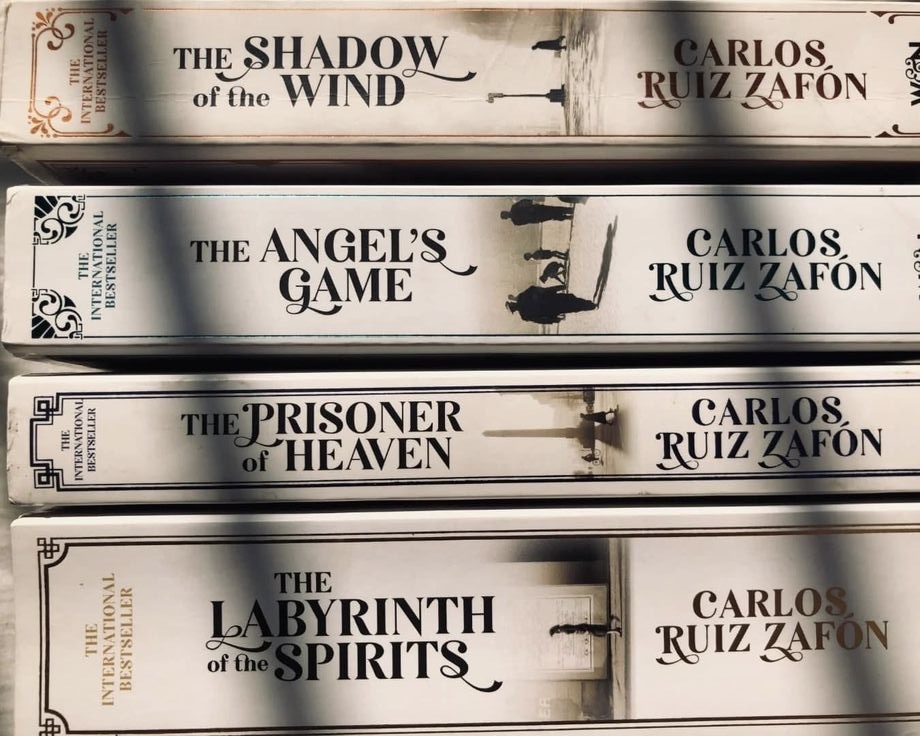
tracing the beauty and narrative mastery of Zafón’s acclaimed book series: The Cemetery of Forgotten Books.
I’m an avid reader, and you would think that because I read so many books, they would all automatically become 5-star reads and I’d praise every single one equally. But that’s not the case at all. I think the opposite has been happening—I’ve become picky about the quality of a book, and the ones on my ‘favorites’ shelf fight long and hard to be up there.
That being said, this is a post about one of those books that made its way to that shelf without a fight, and quite literally from the first chapter on. After having one of my closest friends and my mom (whom I trust blindly with books) recommend this series for so long, I finally started it last summer—and oh boy, the journey this took me on.
I’d also like to add that this series (or even the first book, which can be read as a standalone if you have the willpower to stop there) is perfect for non-readers or if you’re going through a reading slump, and I hope my recommendation will give you at least one good reason why, because this is one of those works that really should be talked about.
I’d also like to add that this series (or even the first book, which can be read as a standalone if you have the willpower to stop there) is perfect for non-readers or if you’re going through a reading slump, and I hope my recommendation will give you at least one good reason why, because this is one of those works that really should be talked about.
The Cemetery of Forgotten Books by Carlos Ruiz Zafón
In the misty streets of Barcelona just after dawn, when the air smells faintly of rain and old stone, some lucky characters turn down a narrow alley and stumble upon a hidden library — a labyrinth of forgotten novels, each waiting for someone to give it life again. This right here, is the beating heart of Carlos Ruiz Zafón’s series, a literary world so rich and intricate that once in it, feels like crossing into another reality.
Zafón (1964 – 2020) was one of Spain’s most celebrated novelists, and he was knows for fusing mystery, romance and history with the emotional depth that great literature carries—and a touch of Gothic atmosphere. The four-part cycle of novels that constitute The Cemetery of Forgotten Books, his most celebrated work, is as follows:
- The Shadow of the Wind (2001)
- The Angel’s Game (2008)
- The Prisoner of Heaven (2011)
- The Labyrinth of the Spirits (2016)
As mentioned before, each volume can stand alone, but together they weave a multi-generational tapestry of secrets, betrayals and love stories that echo across decades, without really making it feel prolonged or repetitive. Every event, relationship and plot development lead back to the secret library (or cemetery) of forgotten books.
“Books are mirrors: you only see in them what you already have inside you.” – Carlos Ruiz Zafón, The Shadow of the Wind
really, why read it?
characters you carry with you (and carry you with them)
It’s difficult not to get attached to the characters of this series. Even after you’ve picked one in the first book to be your favorite, others come and steal the show in the following ones and you end up finding reasons to love them all: Daniel Sempere, the bookseller’s son whose fate is bound to a mysterious novel (book 1); Fermím Romero de Torres, a razor-tongued ex-spy with more charm than anything else (book 3); David Martín, a haunted writer trapped in a bargain that may cost him his soul (book 2); or Alicia Gris, a brilliant but wounded investigator who is on a journey to discover the darkness and shadows of the human heart (book 4).
These are just the main characters of each book, who eventually all meet or know each other already, and there many more that you come to love immensely—or despise to the point of being as angry as the characters facing them. I always felt that if I went to Barcelona, I’d feel the echo of their existence, which itself felt so real in the books.
plots that gradually unfold like secrets
I would describe the way this series is written similar to a mosaic—or better yet, like assembling an elaborate jigsaw puzzle where each piece is a story, and each story changes the meaning of the others. It can be overwhelming to move through overlapping timelines and perspectives, but not in this case. Characters who were background figures in one novel step into the spotlight in another, and conversations gain new significance when seen from different angles.
The books can be read in any order, but reading them all transforms the experience into something rare: a single, sprawling narrative revealed from four different directions. With each book, you get a fresh angle on the same grand mystery that slowly comes together in the end (if there even is an end). I am so amazed at how Zafón created that entire world in his head, and how examples like this one shows how this world rewards patience—the satisfaction comes entirely from watching the puzzle pieces lock into place. There’s always mystery at the core, whether it’s a missing author, a dangerous manuscript or a decades-old betrayal. I’d also like to say this series impressed me with how it dealt with subplots, which can be as essential to the overall feel of a book as the main plots. Zafón includes key historical events, entire family legacies, and even subtle fictional nods to literature itself that contribute to the non-linear timeline of the story.
language as melody
To write about the power of books, memory & identity, love & loss, and the corrupting influence of power all together, Zafón writes with momentum of a thriller writer and the precision of a poet (and I don’t mean rhymes and such).
You’ve probably heard the words “evocative” or “immersive” when talked about literature and description in certain novels, and maybe if you’re like me, you wondered what those words actually meant. I mean, what does it feel like, right? You can use them to describe passages and styles, but you truly know how important or valid they are when you read something like Zafón’s work. Now, I’ve never been to Barcelona, and I think the only image I will ever have of it — even if I go — will be tainted with Zafón’s version of Barcelona: crumbling mansions, candlelit bookstores, and fog-wrapped avenues that come alive through the imagery that he describes so well. He can make you feel the damp chill of an autumn morning or the bittersweet joy of a fleeting romance in a single sentence.
To sum up, it’s really rooted in that Gothic atmosphere I was talking about, notes of romanticism and magical realism, plus a sort of cinematic pacing (he does have a background in screenwriting).
what makes it a masterclass in prose
Prose is the ordinary form of written or spoken language (sentences and paragraphs without the structured meter of poetry). But GREAT prose goes beyond functionality, it can be art. First, I think four major elements from the books help define them as true prose:
- Extended metaphors: literally comparing books to living beings being the biggest one.
- Lyrical cadence: basically sentences that have rhythm without a formal meter, they just do.
- Evocative imagery: your five senses are activated through every description of a smell, taste, feeling…
- Narrative voice variation: shifts between first-person intimacy and omniscient narration, something for everyone.
I don’t want to say Zafón’s work redefined prose, it did better: it reminded his readers what prose is, in a time where some of that might be lost amongst the various writing styles or tones that stray away from it, and might not work. The way this shows is as follows:
- It’s ‘musical’ without being self-indulgent: beautiful sentences aren’t ornaments, they drive the plot.
- It’s a bridge between literary and popular fiction: equally appealing to casual readers and critics.
- It uses description as emotion: scenes and details become expressions and moods.
- And finally, its dialogue is perfection: witty, layered with subtext and giving each character a distinct voice, highlighting the utmost importance of good dialogue, which will never diminish.
All of this to say, you don’t just understand the story—you feel it, and that’s what fiction should do. It’s supposed to touch you and make you inhabit a world someone else created, and how beautiful is that? This is why The Cemetery of Forgotten Books is prose at its finest—the story leaves the paper and invites itself to live with you for a little while.
I couldn’t stop reading these books; I just had to know what was going on at all times. It had been so long since a book made me feel this way—I even felt a little empty after leaving behind the characters I’d grown so used to meeting up with late at night in my tiny bedroom in Paris.
You can wander through the series in publication order, which is the way I did it, though part of the magic is that you could start anywhere really. However you chose to enter those pages, be prepared to read one of the greatest stories conceived, and a little piece of advice: take your time, and don’t read them as fast as I did. This is one of those things where I wish I could erase my memory of the books just to re-experience the times I dedicated to reading these books, and the unmatched wonder of first times.


 the back rows
Leave a comment