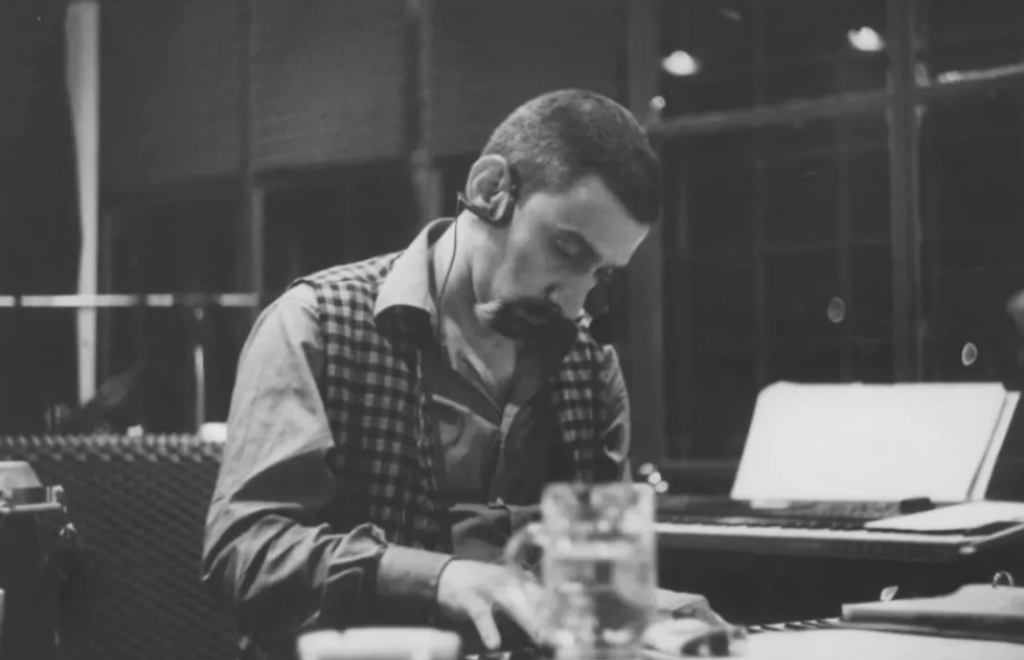
discussing how Ziad El Rahbani didn’t just narrate Lebanon’s chaos — he scored it, staged it, and laughed through it.
Four years ago, when I was writing my first play, one album was playing on loop on my CD player, and that album was Ana Moush Kafer by Ziad El Rahbani. Today, as I write this piece after his passing away last week, the same album is playing. I’m slightly older and more mature to understand it better — and Ziad is gone.
I strongly believe that no matter the number of inspirations and idols we claim to have in our lives, the biggest one is always something from where we’re from—from home. And sadly enough, this realization often comes at the cost of the loss of said inspiration, as the human condition is always marked a bit deeper when it comes to the question of death. We can barely accept death in our own environment — how come some deaths of people we never met hurt just as much?
This piece is going to feel a bit more personal than others, and I’m sure the explanation for it will go far beyond what I’m writing here, so let it be.
who was Ziad El Rahbani?
Ziad El Rahbani, eldest son of legendary Lebanese singer Fairuz and famous composer Assi El Rahbani didn’t resemble his parents in work or in fame. Ziad composed his first song at just 14 years old, and began composing songs for Fairuz at 17, writing his first play at 18. While many call him a child prodigy, a legend, or simply an artist, I’ve found Ziad doesn’t like to label himself. I was watching an interview with him a few days ago and he explains:
“I don’t like the word ‘artist’, it no longer has a definite meaning. If you want to call me something, call me a composer, pianist, singer, playwright, actor and journalist—cite them all if it’s that important to you to label it.” (Translated from Arabic)
No one has ever convinced me more than Ziad that fame is truly a mentality. And he didn’t adhere to it—not in his music, not on stage, and not in his political opinions either. He dared to say anything on his mind, EXACTLY how the actual definition of an artist must be: with no fear, and pleasing no one. This alone is already a major reason why he became a defining voice of Lebanese culture and political critique. In finding ways to define him, I read somewhere that a lot of people dubbed him a complete intellectual and cultural “phenomenon” — and because of the timelessness of his work, I agree.
Ziad’s universe: plays, albums, and the power of protest
As mentioned before, Ziad covered a lot of ground with his work in different fields, which eventually all blend together and complete that idea of a phenomenon I was just talking about.
PLAYS
I think one of my earliest memories from my house in Lebanon was hearing Ziad yelling in his play Shi Fheshil (A Total Failure) (1985) when my mom would play the CD from the TV Room all the way to mine. We don’t have the visual recordings of his plays — I’m not sure they were all recorded or made available to the public — but as I grew older, I started listening to the other ones such as Nazl El Sourour (The Happiness Hotel) (1974), Bel Nesbeh La Boukra Shou (What About Tomorrow?) (1978) and Film Ameriki Tawil (A Long American Film) (1980).
I especially love listening to them on road trips to my house in South Lebanon. Yes, it’s practical because the road is long, but the south also has a long history where words and ideas from the plays resonate the most. The vernacular speech, satire, musical numbers, and political commentary in his plays not only made me fall in love with theater as a whole, but made me, and many others I’m sure, consider the eternal instability of Lebanon more seriously than any politician or news outlet. The call to action lies in the substitution of folklore with dark political humor rooted in urban realities — the harshest look in the mirror you could give any citizen. But that was the philosophy: the truth hurts, do something about it.
MUSIC
Sure, I’d heard the songs Bala Wala Chi (Without Nothing) or Ayshi Wahda Balak (She’s Living Without You) a lot, but I got hooked on both albums Ana Moush Kafer (I Am Not Infidel) (1985) and Houdou’ Nisbi (Relative Calm) (1985) as soon as I found them in my uncle’s CD collection. I just couldn’t comprehend how one album could hold so much commentary on political and social injustices and issues around the country, while the other blended Arabic melodies with jazz, funk, disco and classical harmony in such a way that it was impossible to get songs like Bi Saraha (Honestly) or Rouh Khabbir (Go Tell Them) out of your head for days.
As a playwright, Ziad was a genius with his words and how to use them. This also translated into his musical albums, but as an added bonus revealed his deep connection and passion for composing. To me, Ziad is an audio architect. He treated the studio like an instrument itself, and that can be heard in his pieces. Not only did he layer multiple tracks live, but he also did unconventional things at the times such as add background audio (street sounds, laughs, fake interviews), altered his voice pitch at times for comedic effect, and used analog mixing techniques that added that element of gritty realism to his work.
Ziad El Rahbani was first and foremost a pianist, having studied the instrument from a young age and mastering it with deep classical and jazz influences. I like to think the piano served not merely as accompaniment but as its own narrative voice with its own character in the songs (I think heavily of the introduction to the song Shou Hal Ayyam (What Are These Times?)). Again, differing from his family’s style, he incorporated synthesizers, electric keyboards and organ-style sounds in his songs that gave the compositions that jazz-funk fusion edge to the Arabic bridge. If you listen closely to Houdou’ Nisbi (1985) or Abu Ali (1978) a myriad of other instruments are used in his own style as well: drums and percussions that blend Arabic patterns with jazz swing and latin grooves, orchestral instruments such as saxophone solos, trumpet and trombone, strings that—unlike the romanticized orchestrations of his Rahbani predecessors—are layered introspectively and dissonantly and reflect a smidge of emotional unease. And let’s not forget about the bass, tightly arranged and giving the songs that addictive groove.
I also always smile a little extra when he inserts some laughs, mumbling or words with his regular voice in the background. It kind of feels like breaking the fourth wall in music, infusing the music with intimacy, humor and honesty. I can just picture him in his studio in Hamra having so much fun with the recording—something really felt through his work: fun. I could go on a whole tangent about lyrics and album breakdown, but that deserves its own space, and I am certainly not done talking about Ziad just yet. Right now, I’ve got Bema Enno (Given That) (1995) sitting on my desk, ready for me to discover next.
RADIO & JOURNALISM
Another absolute GEM I’ve found in my mom’s archives is the cassette tapes of Ziad’s radio recordings from his time on the station Sawt El Shaab (Voice of the People). He had a show called El Aakel Zineh (The Mind is an Ornament), which name I am very much obsessed with. I haven’t gone through it yet — and mine and his personalities are about to merge when I do — but from what I know, it was a show where he talked about everything and anything really, critiquing and engaging with political and social issues once again. Ziad also wrote for newspapers across Lebanon namely Al Akbar, where he was calling out injustice, sectarianism and corruption— another reason he was loved by the people, as everyone always said: “Ziad min al shaab” (Ziad is of the people).
WORKS FOR FAIRUZ
A relationship the whole country saw and heard of — Ziad and his mother Fairuz were incredibly influential together, just as they were separately. With Sa’alouni El Nass (People Asked Me) (1972), Kifak Enta (How Are You?) (1991) and much more, Ziad gave Fairuz some darker, jazz-influenced ballads, all the while keeping her image as the woman who sings about love and the country, especially after his father, Fairuz’s partner (personal and professional), passed away early on. In retracing Fairuz’s history, this is an important moment. It showed just how much Ziad had to learn from his parents, and how he took it to a completely new level by further taking Fairy’s insane talent and using it to her advantage in new and improved ways everyone is grateful for today, no matter what they tell you.
what the media couldn’t cover
One of the most interesting things about Ziad El Rahbani is that you will learn so much more from listening to him sing, perform, or speak on the radio than from reading about him online or watching formal interviews. I’ve seen countless of those and I don’t think anyone who actually spoke to him ever truly understood him. I’ve heard people talk ABOUT him that do a better job, people like us who would’ve done anything to ask him the kinds of questions modern-day journalism no longer knows how to ask. When someone like Ziad—who supposedly shied away from the public and the media especially in recent years before his passing away—agrees to speak, you ask the right questions and you don’t waste it. It’s ironic, considering his biggest problems were with those very industries—since they are incredibly politicized in Lebanon—so they already were going to have a hard time getting stuff out of him. Was he truly so difficult to understand? I definitely don’t think so. Now, none of the answers that needed to be shared will see the light of day, except through his work. And his work has plenty of them.
Above all, Ziad served as Lebanon’s conscience: unafraid to mock politicians and sectarian leaders through satire and music, with his dialogue and songs deeply embedded in popular culture today. Like no one else, his art served as persistent critique of injustice, corruption, class exploitation, religious hypocrisy and war profiteering — themes we still desperately need to fight against today—which unfortunately resemble the times in which he was writing about them, only a thousand times more exposed and propagandized.
Even though he became reclusive in later years—not like he was extroverted about himself before, but simply a man who wanted to share what he made with people—younger generations have rediscovered his plays and music and still appropriate them in protests, social media activism, and use his words as anthems of resistance—as they should—and with, I truly hope, even more noise and effect.
Ziad El Rahbani may be gone, but his voice—the one that didn’t shut up and remained unflinching—is still very much here through every lyric, line and laugh he left behind, and it’s not going anywhere anytime soon.
Feature Image Credit: Arab Image Foundation on Instagram

 the back rows
Leave a comment