exploring the understated brilliance of Dire Straits’ debut album.
The setting is this: I’m on a train from London back to Paris, and I’ve got to pick something to listen to. The English countryside is unfurling to my right, it’s a bright, sunny day, and I haven’t had enough of this city yet (I don’t think I ever will). I like to think the music that accompanies us is a big part of makes a trip so memorable—hence why I’m picking Dire Straits as my album of choice, one that hasn’t left my mind since I got hypnotized by the song Six Blade Knife, which happens to be on it. I fear this obsession must be shared here, not only because I love talking about the bands in my music library, but because the more I looped that album, the more intriguing this particular band revealed itself to be.
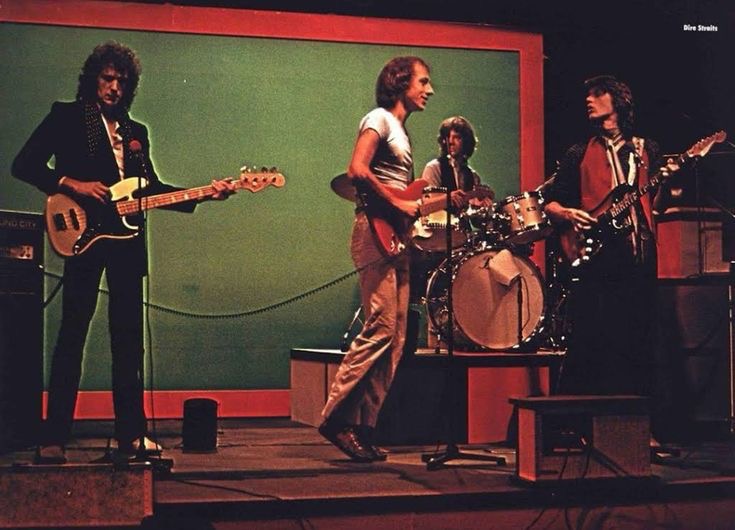
Dire Straits is a rock band formed in 1977 by Mark Knopfler (lead vocalist and lead guitarist), David Knopfler (rhythm guitarist), John Illsley (bassist) and Pick Withers (drummer). Essentially a countercurrent to the dominant punk rock and disco scenes of the late 70s, Dire Straits focused on having a clean, stripped-back sound rooted in blued, country and classic rock. The name of the band rolls off the tongue, but it also has a backstory. The group was quite literally in financial hardship and struggling to find opportunities, which is the literal meaning of the words “dire straits”. A friend of Knopfler’s suggested the name, and its reflection of the band’s humble beginnings and raw authenticity is really what sparked their signature charm.
This debut album, of the same name (Dire Straits), is in my opinion a foundational piece of work in rock music—and not just because Sultans of Swing is on it. Released on October 7th, 1978 by Vertigo Records, the track list is as follows:
1- Down to the Waterline
2- Water of Love
3- Setting Me Up
4- Six Blade Knife
5- Southbound Again
6- Sultans of Swing
7- In The Gallery
8- Wild West End
9- Lions
This might come as a surprise, knowing Dire Straits’s most popular song is on this album, but it actually took a while for it to become successful, before evidently exploding in the US. This was the perfect album to introduce the world to Mark Knopfler’s intricate fingerpicking guitar style.
As I’ve mentioned before, I’ve listened to this album a lot—and always in order. Here’s why: intentional or not, the progression of the album feels both cinematic and natural. In fact, when I first heard it, I had trouble believing this was their first one because of how impressed by it I was. There’s a high level of sophistication in the lyrics, and a clean, atmospheric overall production. You also get a little bit of everything: the feeling of nostalgia in Down to the Waterline, some Delta blues and a desolate mood in Water of Love, an exploration of moral ambiguity in Six Blade Knife, social commentary in In The Gallery, and even an Americana-inflected longing in Southbound Again.
not quite American, not just British
There’s a noticeable American influence on this early record, which explains their success in the U.S. We hear heavy blues and country roots in the way Mark Knopfler uses slide guitar, open tunings and laid-back grooves that make it sound like the songs are coming out of Mississippi Delta or Nashville. The songwriting also feels like storytelling, which reminds me of Bob Dylan or Bruce Springsteen’s works as they were always full of characters, scenes and observations. Knopfler’s dry and understated singing style makes us feel like he’s talking to us, which I think pairs beautifully with this particular genre of music, and obviously, his guitar style has much more in common with American bluesmen and country pickers than with British hard rock or punk guitarists.
What I think Dire Straits do better though is the opposite of this, i.e. have their own distinct British perspective added into the mix, which made them popular outside of the U.S as well with a fluidity that escaped others. They wrote about British life—especially urban, working-class experiences that resonated with a wide audience—like in the song Wild West End. They might have resembled American music in specific aspects of style, but their tone was unmistakably British. This album and the great ones that followed have an overall understated complexity characterized by minimal production, which is what lets the guitar work and lyrics shine. The fingerpicking style avoids power chords and distortion in favor of subtle dynamics and melody—almost anti rockstar in times of showmanship and volume.
In 1978, this is refreshing and anachronistic. The album remains timeless (exhibit A: what I’m writing here), and I think its core strength is that it never tried to follow a trend, but blended inspiration and identity— carving out a hybrid quality that granted the group a unique transatlantic space.
In 1978, this is refreshing and anachronistic. The album remains timeless (exhibit A: what I’m writing here), and I think its core strength is that it never tried to follow a trend, but blended inspiration and identity— carving out a hybrid quality that granted the group a unique transatlantic space.
my favorite tracks
I’m not going to pull a cliché and say “I can’t pick just a few tracks I love them all!”, no, I won’t waste your time. So, here they are:
- Down to the Waterline
The more I listen to this song, the more I feel like this is the first time I’m hearing it and I absolutely HAVE to show it to everyone I know (which is precisely what I did, ask my whole family). I rarely deem an opening track appropriate or close to perfect on an album, but this definitely is. Down to the Waterline is my Sultans of Swing. A rather obvious choice, but the 53 second introduction of the guitar echoing and percussions humming like shivers running down your spine doesn’t even begin to prepare you for the sudden shake once the guitar starts. The way this song progresses illustrates exactly the focus on lyrics and melody being in perfect tandem aforementioned. I absolutely love Knopfler’s deep vocals and the way the guitar pauses for a second so we can hear the words that fill the entire sound space. One of my favorite things in music is when a singer drops to a low pitch unexpectedly. If you want specific timestamps to know what I’m talking about: 1:53, 2:30, 3:32. In terms of storytelling as well, it really does make you want to go down to that waterline that he makes seem so appealing.
- Six Blade Knife
This song is ethereal to me. It is one of the most beautiful guitar works I’ve ever come across, and the raspiness of Knopfler’s voice in this one gives it a slight edge that exudes emotional vulnerability. The lyrics almost feel like they describe the knife as surgical, not a weapon. I suppose he’s talking about some sort of toxic or manipulative relationship where he himself is being hurt, yet he allows it—maybe even needs it. A lyric that really stands out to me is:
“You take away my mind like you take away the top of a tin”
This simile is so domestic and mundane, but so effective, because removing the top of a tin is simple and mechanical, and suddenly revealing. So comparing having his mind undone to popping open a can is just showing that there’s no barrier—he’s mentally or emotionally laid bare, and that’s what gives the line its emotional weight. This song to me is also a great example of why mood over drama works well, because it’s musically spare—mostly rhythm guitar, bass and hushed vocals, but mirrors the internal struggle and lack of clarity. Therefore, relatable.
- In The Gallery
If the act of sitting on a calm, slightly windy beach, opening a can of whatever it is you’d like to drink, taking a sip, and instantly feeling refreshed was a song, this would be it. In the Gallery is definitely interesting for its critique of the commercialization of art, exploitation of working-class talent and the hypocrisy of the art establishment in general. The writing suggests that there is a striking contrast between authentic, working-class creativity and the elite, opportunistic gallery world, and it’s a very subtle protest song. But what my ears caught on that makes this song stand out from the others is the musical style. If you listen closely, the song sort of flirts what the rhythm and groove of early reggae or a genre called rocksteady. It’s relaxed and slightly off-beat at times, Pick Withers’ drumming is light and spacious, John Illsley’s baseline is melodic and steady, reminiscent of Jamaican one-drop rhythms, which I found fascinating. It’s not a reggae song structurally at all, but it definitely borrows the feel and rhythmic discipline and adapts it into Dire Straits’s own style. Its uniqueness is why I really like it.
a word on Mark Knopfler
The more I dived into the band and the guitarist’s work, the more I am convinced he is one of the most distinctive and technically brilliant guitarists in rock history. The importance of the fingerpicking technique really dawned on me as being this incredibly tactile connection to the instrument itself. What I’ve realized is Knopfler doesn’t overplay. Instead, he served the mood and melody of the song, letting the spaces and silences do as much talking as the notes. No wonder it flows so nicely. His respect and hybridity of influences is something I also really admire, as he drew from blues, country, jazz and folk genres and artists to create his own unique sound (notable influences: B.B. King, Chet Atkins, Eric Clapton, Bob Dylan, Joni Mitchell, Leonard Cohen, and much more).
At the end of it, this fusion of American roots authenticity, British melody precision and poetic storytelling helped Dire Straits have a sound that I would like to say is deeply human. This album is again, key to understanding and feeling rock music, and will be a beautiful listen if you decide to check it out.

 the back rows
Leave a comment